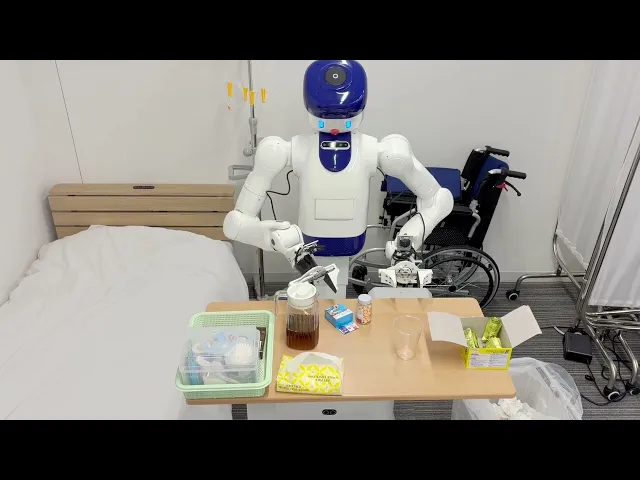
US Physical Intelligence (π) Features "D1" as an Early Case Study for Pi API

~ Early access to Pi API prior to beta release. Learned tea-serving tasks with 97 demonstration datasets, confirming potential for multi-robot deployment ~
ZEALS Co., Ltd. (Headquarters: Meguro-ku, Tokyo; CEO: Masahiro Shimizu; hereinafter "ZEALS") announces that its semi-domestic compact humanoid robot "D1" was featured as an early adoption case for Pi API in the technical announcement "Frontier Models for Every Robot: Announcing our API beta" published on October 13, 2026, by US-based robot AI R&D company Physical Intelligence (π, hereinafter "π").
Prior to the public beta release of the Pi API, ZEALS participated in an early access program provided to a select group of companies, working on training and validating robot foundation models for D1. Additionally, ZEALS has been collaborating closely with π's R&D team to advance post-training of the latest robot foundation model, "π0.7", specifically for D1.
In the achievements highlighted, a model trained on 97 demonstration runs enabled D1 to successfully execute a tea-pouring operation across all 10 trial attempts. Furthermore, it was confirmed that the trained model operated on a second D1 unit without requiring camera calibration for individual machines, which was previously necessary.
These results demonstrate the ability to adapt to new tasks with small datasets and highlight the potential for transferring learned skills across multiple robot units.
Moving forward, ZEALS will continue to combine world-leading robot foundation models with D1 development technology tailored for Japanese operational sites, enhancing the autonomy and field capabilities of humanoid robots to drive social implementation.
1. About Physical Intelligence (π) and Pi API
Physical Intelligence (π) is a San Francisco-based company researching and developing general-purpose robot foundation models that enable diverse robots to execute a wide range of tasks.
The company focuses on developing Vision-Language-Action (VLA) models that generate robot actions based on visual information and language instructions. In April 2026, π announced "π0.7", aimed at achieving higher generalization capabilities than before.
On October 13, 2026, the company announced the beta version of "Pi API", allowing robotics companies to perform additional training and inference for foundation models using their own proprietary data.
Pi API allows companies to upload robot demonstration data, conduct post-training on compute infrastructure managed by π, and deploy the trained models onto physical hardware.
By reducing the burden on individual companies to build large-scale AI training infrastructure, Pi API aims to streamline the development cycle from robot action data collection to training, evaluation, and improvement.
Prior to releasing the beta version, π provided early access to Pi API for a small number of robotics companies to test its applicability across various hardware and task types.
As one of the participating early access companies, ZEALS conducted model training and evaluation using D1, the results of which were highlighted in this official announcement.
2. Learning Tea-Serving Operations from 97 Demonstration Datasets, Achieving 100% Success Across 10 Trials
In developing the semi-domestic compact humanoid "D1", ZEALS focuses not only on hardware design suitable for Japanese operational environments, but also on advancing software and AI models for robot control.
In this development initiative utilizing π's robot foundation model, post-training and real-world robot testing were conducted targeting D1's "tea-pouring action."
Using a model trained on 97 demonstration runs, D1 successfully performed the tea-pouring action in 10 out of 10 attempts under specific verification conditions.
Conventionally, teaching robots a new task required extensive data collection, model training, and motion tuning tailored to specific robot hardware and work environments.
Leveraging general-purpose robot foundation models allows existing action knowledge to be reused, potentially reducing the required data volume and development overhead for customizing models to specific tasks.
This achievement demonstrates the capability to teach new actions to D1 using relatively small demonstration datasets, marking an important technical milestone toward expanding supportable tasks in the future.
3. Deploying Trained Models to Additional D1 Units, Reducing Per-Unit Tuning Overhead
This initiative also confirmed the potential to deploy learned behaviors directly to other D1 units.
With traditional models, applying trained skills to different robot units required per-unit calibration to adjust for slight discrepancies in camera positioning and geometry.
In contrast, the newly trained model successfully operated on a second D1 unit without requiring the camera calibration typically needed for individual machines.
This highlights the capability to transfer learning outcomes obtained on a single robot to other hardware units.
To scale the real-world adoption of humanoid robots, it is essential not only to expand task versatility but also to efficiently deploy and operate multiple units.
Reducing unit-specific adjustment work is expected to lower development and deployment overhead when expanding trained models across multiple D1 units performing identical duties.
ZEALS will continue validating these technologies to advance model development and operational infrastructure supporting mass production and deployment scaling for D1.
4. Future Outlook | Accelerating D1 Social Implementation via Cutting-Edge Robot Foundation Models
ZEALS is actively advancing the real-world deployment of D1 targeted at Japanese healthcare and caregiving facilities facing labor shortages.
In August 2026, proof-of-concept (PoC) trials were conducted at Juko Daisu Hospital, followed by trials in September at Ojakoshi Group nursing care facilities. These trials evaluated D1's feasibility and operational challenges across tasks such as guidance, light item transport, and serving tea.
Additionally, shipments of D1 commenced on October 1, 2026, transitioning insights gained from field trials into ongoing, continuous operations across real-world environments.
Expanding the societal adoption of Physical AI requires enhancing adaptability across diverse onsite tasks, while minimizing the labor required for unit-specific training and calibration to establish a sustainable deployment pipeline.
The technical validation achieved through this partnership with π—specifically action learning from small demonstration datasets and cross-unit model deployment—represents key progress toward resolving these challenges.
Going forward, we will accumulate model training and validation based on operational requirements in real fields to expand D1's operational scope. Furthermore, we aim to build development and operational frameworks that leverage learning achievements from a single unit across other machines to streamline multi-unit deployment.
ZEALS has set targets for FY2026 to mass-produce 100 D1 units and reach a cumulative 10,000 operational hours in the field.
By combining field data gathered during D1 deployments with global state-of-the-art AI technologies, we will establish a continuous development feedback loop spanning field operation, data collection, AI model training and improvement, and multi-unit expansion.
By bridging global frontier robot foundation models with domain technology and operational expertise cultivated in Japanese field settings, we strive to enhance D1's autonomy and task performance, realizing a society where humans and robots work side-by-side.
Related Information
Physical Intelligence Official Announcement: "Frontier Models for Every Robot: Announcing our API beta"
https://www.pi.website/blog/api-beta
Physical Intelligence: "π0.7: a Steerable Model with Emergent Capabilities"
https://www.pi.website/blog/pi07
D1 Official Website
https://omakaserobotics.ai/