Categories
News

ZEALS Deploys Compact Humanoid D1 at a Sakurajuji Group Nursing Care Facility for the First Time

D1 Completes 15 Hours of On-Site Operation with No Collisions or Falls, Validating Elevator-Based Guidance, Lightweight Item Transport, and Tea Serving

ZEALS Co., Ltd. (Head Office: Meguro-ku, Tokyo; CEO: Masahiro Shimizu; hereinafter “ZEALS”), with the cooperation of the Sakurajuji Group, conducted a two-day proof-of-concept (PoC) demonstration using the compact humanoid robot D1 at Hospitalment Bunkyo Sendagi, a private nursing home with nursing care services, from Thursday, September 10 to Friday, September 11, 2026.

The PoC evaluated three tasks: (1) facility guidance involving elevator use, (2) transportation of lightweight items such as supplies and deliveries, and (3) pouring tea from a pot into cups.

ZEALS has previously tested D1 in hospital environments for tasks including visitor guidance, lightweight item transport, operation of tea-serving equipment, assistance with clearing meal trays, and leading exercise sessions. This latest PoC expanded the testing environment to a nursing care facility where residents live their daily lives.

In addition to movement within a single floor, D1 was tested on inter-floor travel using elevators, transportation of items between floors, and tea-serving tasks involving the handling of liquids. Through these trials, ZEALS assessed D1’s potential to adapt to everyday operations in nursing care facilities and identified challenges that must be addressed ahead of practical deployment.

D1 website: https://www.omakaserobotics.ai/

1. Background of the Proof of Concept

At nursing care facilities, caregivers and nurses are responsible not only for providing care to residents but also for a wide range of everyday tasks, including transporting supplies and linens, preparing beverages, guiding people around the facility, and facilitating recreational activities. While each of these tasks is essential to facility operations, their repetitive nature can place a significant physical and time burden on staff.

If robots can take on some of these ancillary tasks, facility staff could spend more time communicating with residents and providing care tailored to each individual’s needs.

ZEALS has previously tested D1 in hospital environments for tasks including guidance, item transportation, operation of tea-serving equipment, assistance with clearing meal trays, and leading exercise sessions. Nursing care facilities, however, differ from hospitals in that they are first and foremost places where residents live their everyday lives. Robots therefore need to operate while respecting residents’ daily routines and ensuring safety in environments where residents, staff members, and visitors are constantly moving around.

Against this backdrop, ZEALS deployed D1 at Hospitalment Bunkyo Sendagi, operated by the Sakurajuji Group, to test three tasks based on everyday operations in a nursing care facility. The initiative was designed to examine how technologies developed through ZEALS’ hospital trials—including conversational interaction, perception, autonomous navigation, and dual-arm object manipulation—could be applied to nursing care and daily-life support.

2. Overview of the Proof of Concept

  • Dates: September 10 (Thu.)–11 (Fri.), 2026

  • Location: Hospitalment Bunkyo Sendagi

  • Robot: Compact humanoid D1

  • Organizer: ZEALS Co., Ltd.

  • Cooperation: Sakurajuji Group and Hospitalment Bunkyo Sendagi

  • Primary tasks tested: Facility guidance, lightweight item transport, and tea serving

Hospitalment Bunkyo Sendagi is a private nursing home with nursing care services accommodating up to 50 residents across 48 rooms. The facility is a four-story building with nurses and caregivers on-site 24 hours a day.

On the first day, the team brought D1 into the facility, established its network connection, created a map of the facility, adjusted its navigation system, and progressively tested each task. On the second day, the team incorporated navigation data and adjustments from the previous day and conducted further task validation while collecting real-world operational data.

3. Main Tasks Evaluated

① Facility Guidance and Navigation

D1 autonomously navigated corridors and common areas based on a previously generated map of the facility, while also being tested on inter-floor travel using elevators and guiding people to destinations within the building.

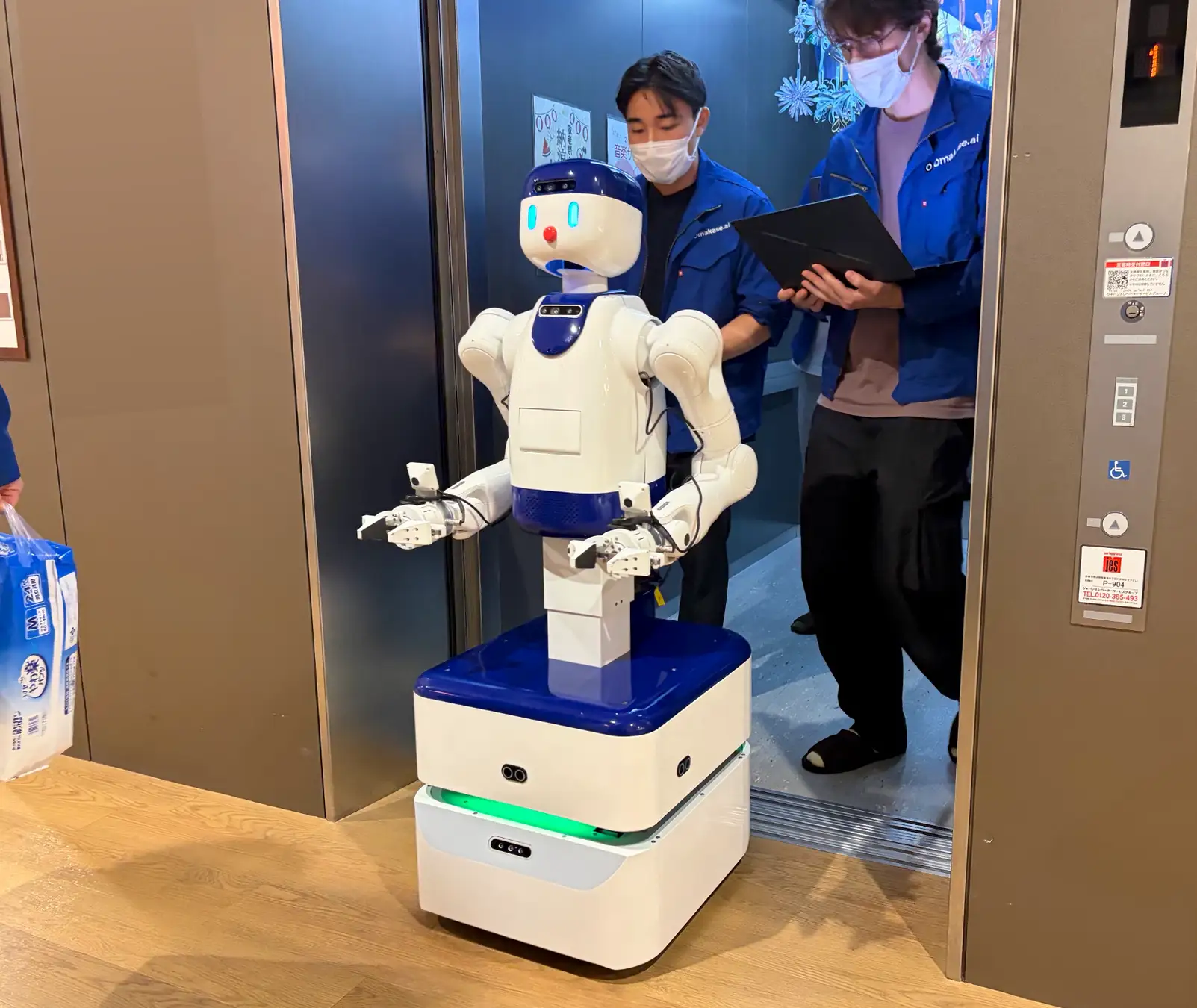
When staff members spoke to D1, the robot autonomously guided them to destinations such as the office, entrance, restroom, and elevator. When using the elevator, D1 boarded together with people, exited at the designated floor, and continued autonomously to the destination. The team also confirmed that D1 could travel to the fourth floor and guide people to areas including the rehabilitation space and residents’ rooms.

Residents and staff members routinely move throughout the facility. D1 continued navigating while detecting nearby pedestrians and obstacles using cameras and sensors and adjusting its route accordingly. D1 also engaged in natural conversations with residents it encountered during the guidance task.

By using the facility’s existing elevators without requiring major modifications to the building infrastructure, the PoC demonstrated a practical approach to inter-floor mobility for humanoid robots in nursing care facilities.

Key validation items

  • Autonomous navigation through corridors and common areas based on a previously generated facility map

  • Confirming destinations through conversation

  • Guidance to the office, entrance, restroom, and elevator

  • Guidance to the rehabilitation area and residents’ rooms

  • Navigation in an environment where residents and staff members are continuously moving

② Transportation of Lightweight Items

Unlike medical facilities, nursing care facilities are living environments where residents spend their everyday lives. As a result, staff members routinely transport not only nursing care supplies but also a wide variety of items associated with residents’ daily lives, including products ordered by residents, while simultaneously carrying out caregiving duties.

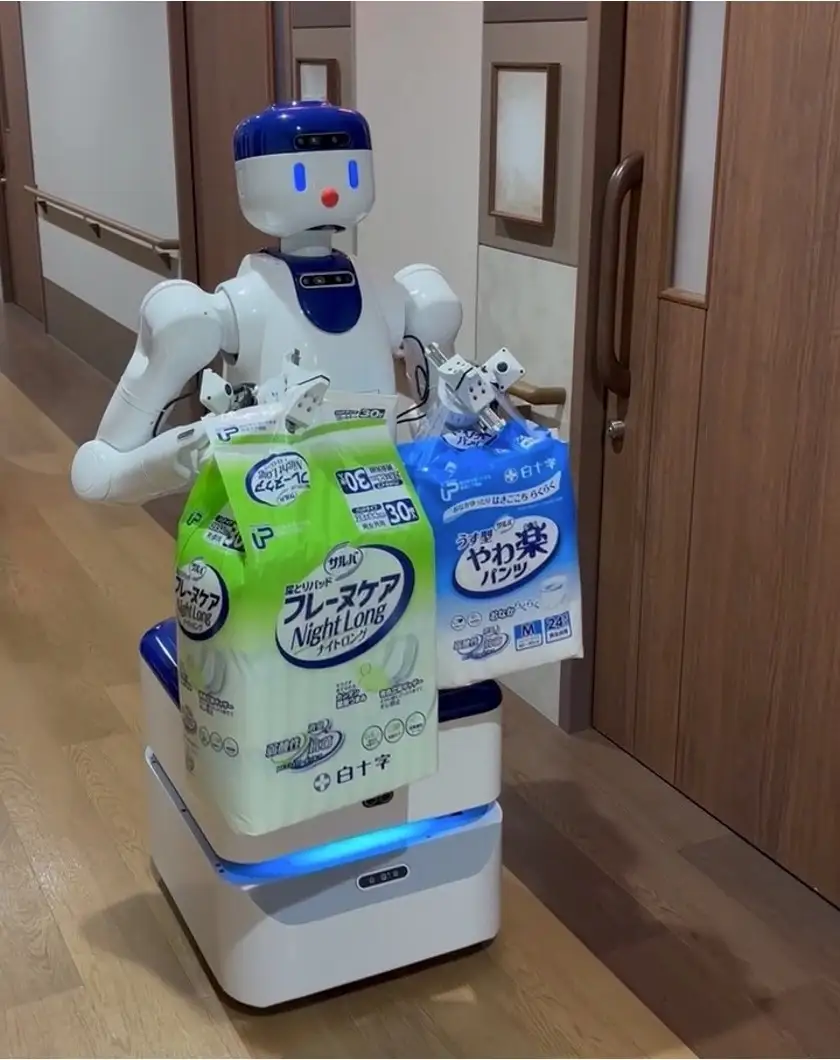
This PoC examined the potential for D1 to take on some of these transportation tasks. In the office, D1 received items directly from staff members, confirmed the delivery destination verbally, autonomously traveled while holding the item, and delivered it to the designated resident’s room.

Specifically, D1 transported adult care diapers from the office to a resident’s room. It also delivered an item ordered by a resident to the resident’s room. The latter was not a package prepared in advance for testing, but an actual delivery request that arose at the facility on the day of the PoC and was handled by D1 as part of the real-world operation.

Building on the navigation capabilities tested during the facility guidance task, the team assessed whether D1 could perform the combined action of navigating while securely holding an object. The testing also helped identify the range of item weights and shapes that D1 is currently capable of transporting.

Key validation items

  • Grasping and lifting items handed directly to D1 by staff

  • Confirming delivery destinations through conversation

  • Navigating from the office to a resident’s room while holding an item

  • Delivering the item to the designated resident’s room

③ Tea Serving

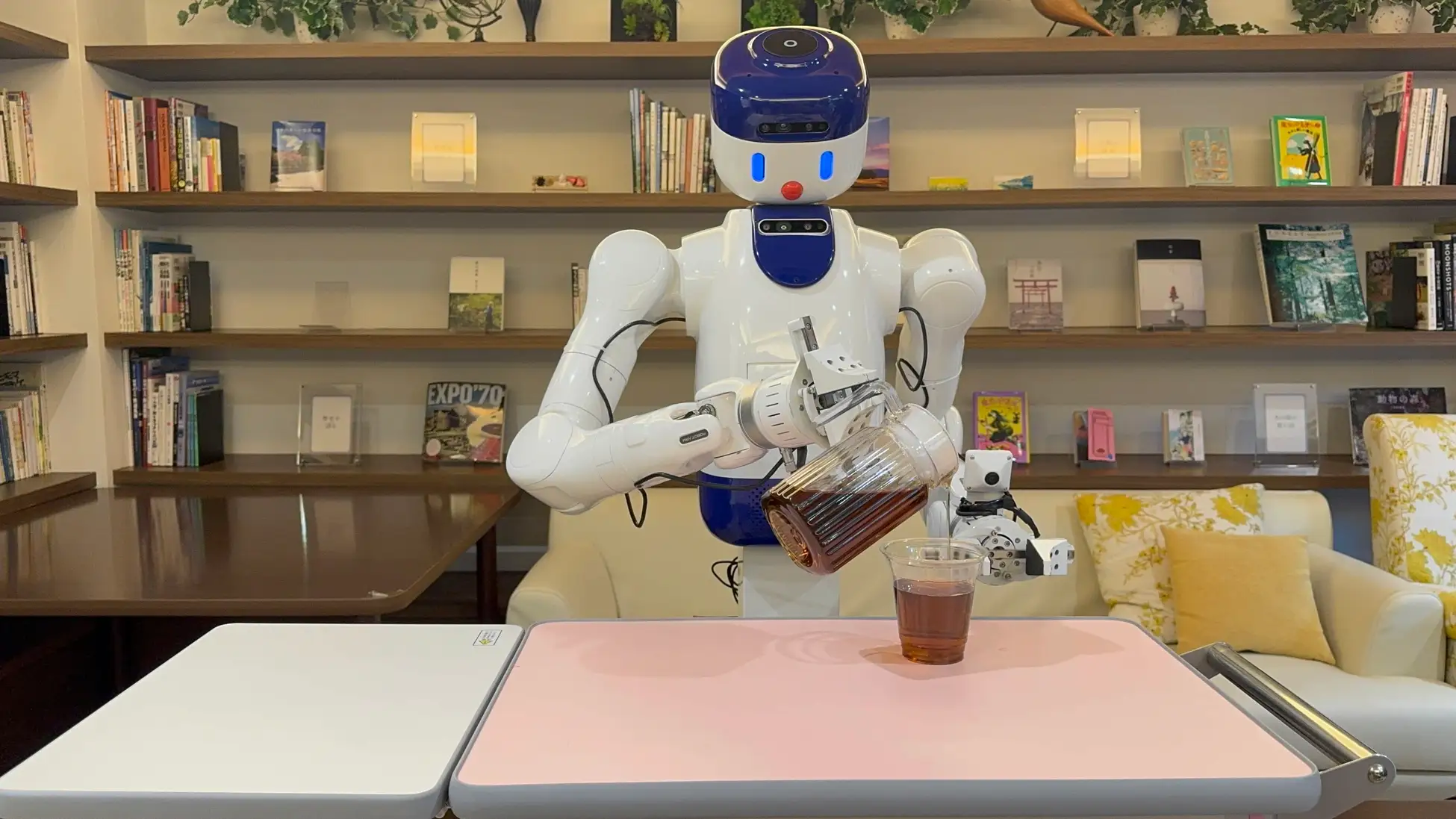
The team tested the complete sequence of D1 pouring tea into a cup and returning the pot to its original position.

D1 recognized the positions of the pot and cup in real time, lifted the pot, monitored the amount of tea being poured into the cup, and determined both the appropriate pouring angle and when to stop pouring. All of these actions were performed autonomously by D1 without remote operation.

The test confirmed the potential for D1 to autonomously perform tea-serving tasks even in an environment different from the one in which the task had been trained. At the same time, challenges remained in terms of movement stability and reproducibility.

Going forward, ZEALS will use the data collected during the PoC to further train and improve individual actions, including recognizing the pot and cup, grasping the pot, and pouring liquid, with the aim of enabling D1 to perform the entire sequence more consistently.

The PoC also helped ZEALS assess the potential reduction in staff workload associated with beverage preparation and better understand the amount of training data and operating conditions required for practical deployment.

Key validation items

  • Recognizing the pot handle and securely grasping and lifting the pot

  • Controlling the pouring angle to regulate the amount of liquid dispensed

  • Assessing the amount poured into the cup and determining when to stop

  • Returning the pot to its original position after pouring

  • Autonomously performing the complete sequence without remote operation

4. Significance of the PoC and Next Steps

This PoC expanded D1’s testing environment from hospitals to a private nursing home with nursing care services, with the aim of identifying specific tasks that humanoid robots can perform in residents’ living spaces as well as operational challenges that must be addressed.

D1 operated on-site for eight hours on the first day and seven hours on the second day, for a total of 15 hours across the two-day PoC.

For facility navigation, the team tested inter-floor movement using elevators, expanding the range of environments in which D1 can operate and the scope of tasks it can potentially perform. For lightweight item transport, the PoC assessed D1’s potential to support part of the routine transportation work currently carried out by facility staff. For tea serving, the team collected real-world data required for precise manipulation involving liquids.

In August 2026, ZEALS conducted its first D1 PoC in a medical setting at Keimeikai Medical Corporation’s Juko Osu Hospital. D1 operated for a total of 35 hours over three days and was tested across five hospital tasks, ranging from visitor guidance to assistance with clearing meal trays. Throughout the trial, there were no collisions with people or facility equipment and no falls, confirming D1’s ability to perform tasks in an active medical environment where patients and staff members move throughout the facility.

By expanding the testing environment to a nursing care facility in this latest PoC, ZEALS has now continuously demonstrated, within a span of just over two weeks, D1’s ability to perform real-world tasks in two distinct environments—medical care and nursing care—with zero collisions with people and zero falls in both settings.

ZEALS will use the data collected through these PoCs to further train, evaluate, and improve D1. Together with the Sakurajuji Group, ZEALS will also explore specific use cases for humanoid robots in nursing care facilities and discuss opportunities to expand deployment to other Hospitalment facilities.

Comment from Makoto Sugaya, Head of Operations, Sakurajuji Group

“As labor shortages in the nursing care sector continue to intensify, reducing the workload placed on staff has become an increasingly important challenge.

While we are considering potential applications for direct care assistance in the future, we believe that beginning with the automation of everyday tasks such as transporting items and guiding people around the facility could provide significant support to frontline staff.

The value of this initiative extends beyond simply improving operational efficiency. By freeing up time, staff members can devote more attention to conversations with residents and to the warm, human-centered care that only people can provide. This trial represents an important first step in determining whether humanoid robots can evolve into an indispensable presence capable of supporting practical work in the nursing care sector.

Before deployment, we had some concerns about how residents might react to the robot. In practice, however, D1 was accepted smoothly without any significant resistance, and residents responded positively to its endearing movements and expressive behavior.

We see significant potential for D1 to contribute as a member of the team working alongside staff within the facility while helping reduce their workload. Based on the insights gained through this trial, we will continue working with ZEALS to develop concrete operating models that can deliver genuine value in nursing care settings.”

Makoto Sugaya
Head of Operations, Hospitalment Business Division
Medical & Nursing Care Well-Care Business Headquarters
Sakurajuji Group

About D1

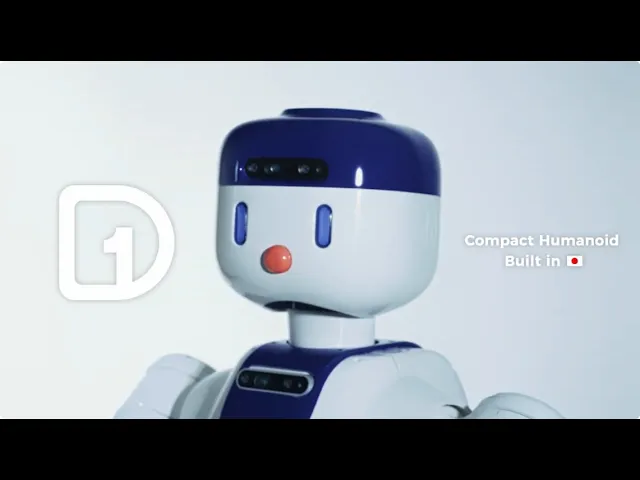
D1 is a compact humanoid built in Japan, designed to share indoor space with people and to take on specific tasks.

ZEALS sources parts and technology worldwide, and leads in Japan on AI, software, control, assembly, and how the robot is introduced and run on site.

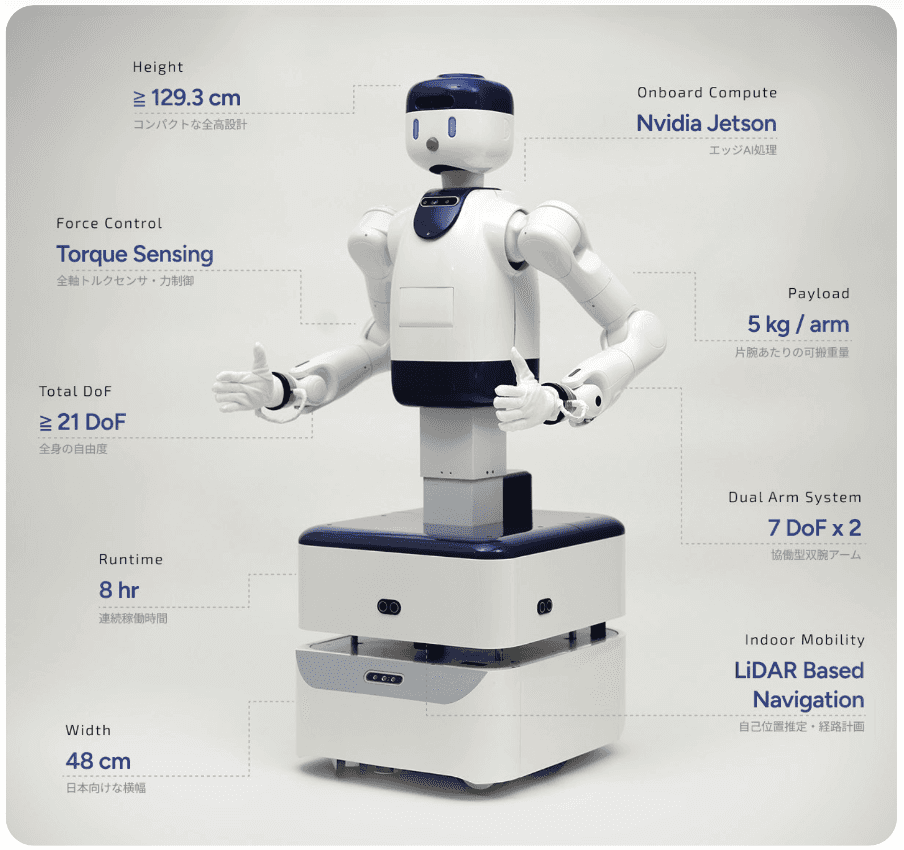
D1 stands about 129.3 cm tall, with a mobile base about 48 cm wide. It is being built for natural conversation, reception and guidance, autonomous navigation, obstacle avoidance, and multiple languages, and is being extended into physical work such as preparing supplies, carrying items, and handing them over with two arms.

Pricing is planned to start at JPY 5 million per unit. Sales inquiries opened on August 5, 2026.

■D1 site: https://www.omakaserobotics.ai/en

About the Sakurajuji Group

“WELL-BEING FRONTIER — Enriching Life in the Era of 100-Year Lifespans.”

Under its mission of “Enriching Life in the Era of 100-Year Lifespans,” the Sakurajuji Group operates a wide range of businesses and services designed to enhance people’s well-being and quality of life across three areas: Medical, Experience, and Solution.

Group website: https://sakurajuji.com/

About ZEALS

Company name: ZEALS Co., Ltd.
Established: April 1, 2014
Capital: JPY 100 million
Head office: ARCO Tower 6F, 1-8-1 Shimomeguro, Meguro-ku, Tokyo, Japan
Representative: Masahiro Shimizu, Representative Director and CEO
Business: Development and provision of Omakase AI, D1, Omakase Zen, Omakase OS, ZEALS AI Agent, and related products and services

Corporate website: https://zeals.ai/jp/
D1 website: https://omakaserobotics.ai/

News

ZEALS Completes First Hospital Deployment of D1 Humanoid, Evaluating Five In-Hospital Tasks Over 35 Hours

The trial ended with no contact with people and no falls. D1 was tested on visitor guidance, light transport, tea service, tray clearing, and leading exercise.

ZEALS, with Tokyo-based CUC Inc., ran a three-day proof of concept of its compact humanoid D1, built in Japan, at Juko Osu Hospital, part of Keimeikai Medical Corporation, from Wednesday, August 26 through Friday, August 28, 2026.

The trial covered five in-hospital tasks: visitor guidance, light-item transport, preparing tea at a tea dispenser, tray clearing, and leading exercise sessions.

Hospital safety came first. Operating areas and hours were set in advance. ZEALS robotics engineers stayed on site, ready to switch to remote control or an emergency stop if needed. D1 worked around pedestrians, wheelchairs, and clinical staff.

All planned tests were completed over the three days. D1 did not touch anyone and did not fall. The trial showed that, with those safeguards in place, D1 can share space with people in a working hospital and take on several support tasks.

ZEALS will use the field data and staff feedback from this trial to keep testing safety and reliability, and to improve D1's autonomy, task quality, and fit to each site.

D1 site: https://www.omakaserobotics.ai/en

1. Background

Hospitals already face a chronic staffing shortage. Nurses, clinicians, and administrative staff handle a long list of support work on top of patient care, including guiding visitors, moving documents and supplies, serving tea, clearing trays, and making rounds.

That work comes up every day and costs staff time and physical effort. Supporting some of it with technology would let clinicians spend more of their time on patients and on clinical judgment, without lowering the quality of care.

ZEALS has been testing whether humanoid robots can do this kind of work in hospitals.

In March 2026, ZEALS ran a proof of concept at University of Tsukuba Hospital with a commercially available Unitree G1 humanoid running Omakase OS, ZEALS' software suite for humanoids. That trial covered autonomous walking, obstacle avoidance, conversational wayfinding, transport, and anomaly detection. All planned tests were completed, with no contact with people and no falls.

That release is here: https://prtimes.jp/main/html/rd/p/000000190.000019209.html

In June 2026, ZEALS used the dual-arm mobile manipulator Galaxea R1 Pro to move light items and to recognize, pick up, and place supplies for blood-draw preparation. For two-armed work, ZEALS built Omakase Zen, a manipulation model, expanding from the OS into AI, and ran that trial as well.

This trial went a step further. Along with the OS and AI models, ZEALS brought its own hardware: D1, a humanoid designed for Japan's tight indoor spaces. It was D1's first test in a real hospital.

ZEALS put the technology from those earlier trials onto D1 and tested whether conversation, perception, autonomous navigation, and two-armed manipulation could fit the day-to-day work of nurses and nursing assistants.

2. Trial Overview

Period: Wednesday, August 26 to Friday, August 28, 2026
Location: Juko Osu Hospital, Keimeikai Medical Corporation
Robot: compact humanoid D1, built in Japan
Organizer: ZEALS
Partners: CUC Inc. and Juko Osu Hospital, Keimeikai Medical Corporation

The five tasks were run in areas and time windows chosen for safety, based on the hospital's real corridors, equipment, and daily operations.

On day one, D1 was brought in, connected to the network, and mapped to the building. Navigation was tuned, and the guidance task was rehearsed. On day two, guidance, light transport, tray clearing, and tea-dispenser use were tested one at a time. On day three, each task was run again for a final check, and data was collected.

The hospital's own procedures were followed. When patients were involved, the trial was explained in advance, and only people who consented took part. Photos and video were used only within that consent.

ZEALS robotics engineers stayed on site throughout, with remote control and an emergency stop ready. Operating areas were adjusted around hospital traffic and emergency routes. Ordinary hospital work and safety came first.

All planned tests were completed. D1 did not touch anyone and did not fall.

3. Tasks Tested and Results

1. Visitor guidance at the health screening center
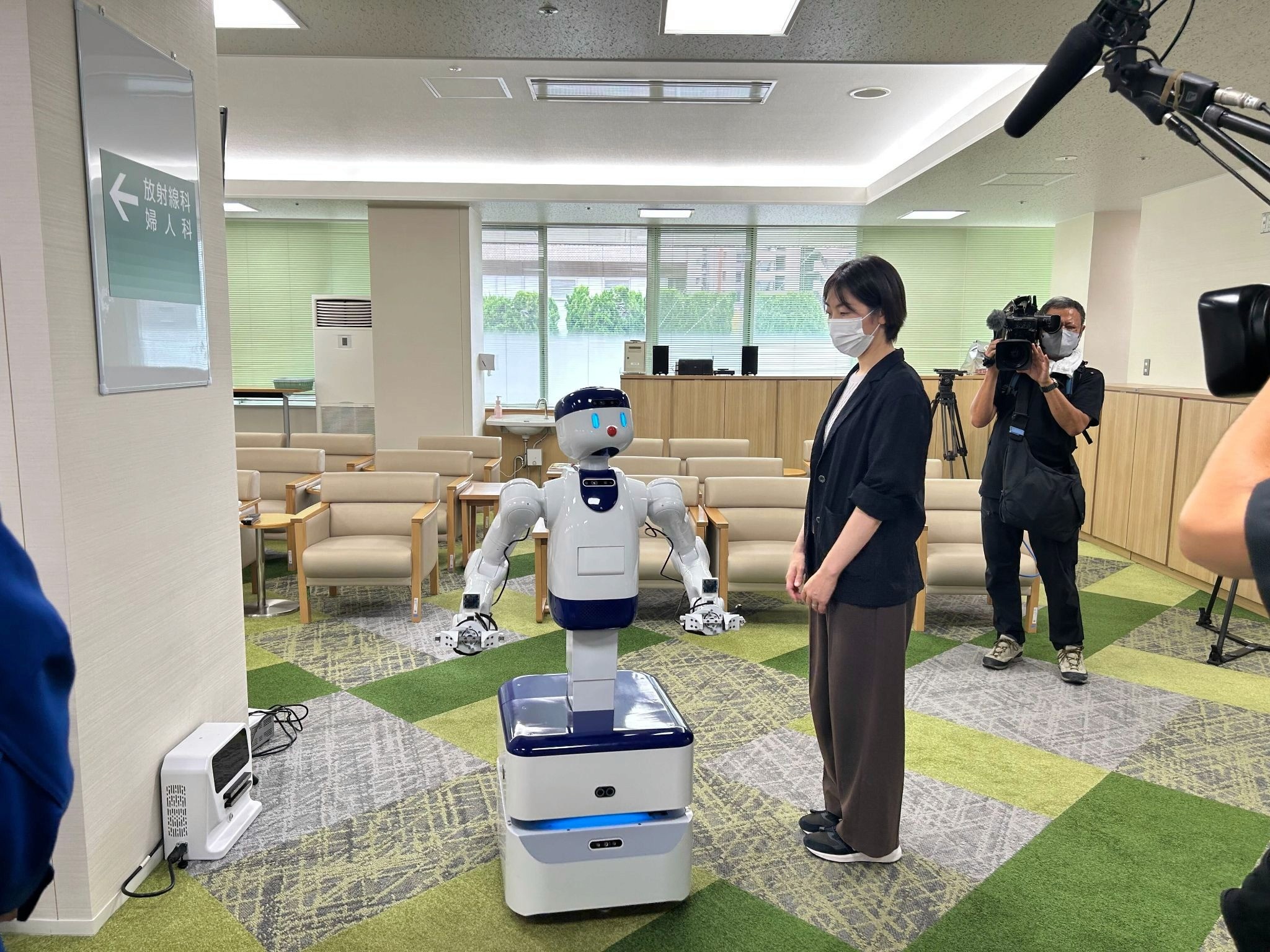
In the first-floor lobby, at reception, and in the health screening center, D1 helped visitors who were unsure how to reach their next exam room. Some screenings at Juko Osu Hospital take place on other floors or in other buildings, so patients get lost, and staff have to help each time. D1 was tested on that guidance work to take some of that load off staff.

D1 asked visitors where they needed to go, then used live camera and sensor data to watch for people and obstacles while walking them toward their destination.

A working hospital is shared by visitors, staff, and people using wheelchairs or crutches. D1 waited inside the screening center so it would not block ordinary work. The trial checked whether talking, guiding, and moving could work on real hospital routes.

What was tested

  • Guiding visitors around the health screening center

  • Responding in the language used to address D1

  • Confirming the destination in conversation

  • Walking visitors toward that destination

  • Moving among pedestrians and obstacles

Result: The planned guidance and movement were completed without contact, falls, or other incidents.

2. Light transport among exam rooms, the health screening center, and the community welfare office
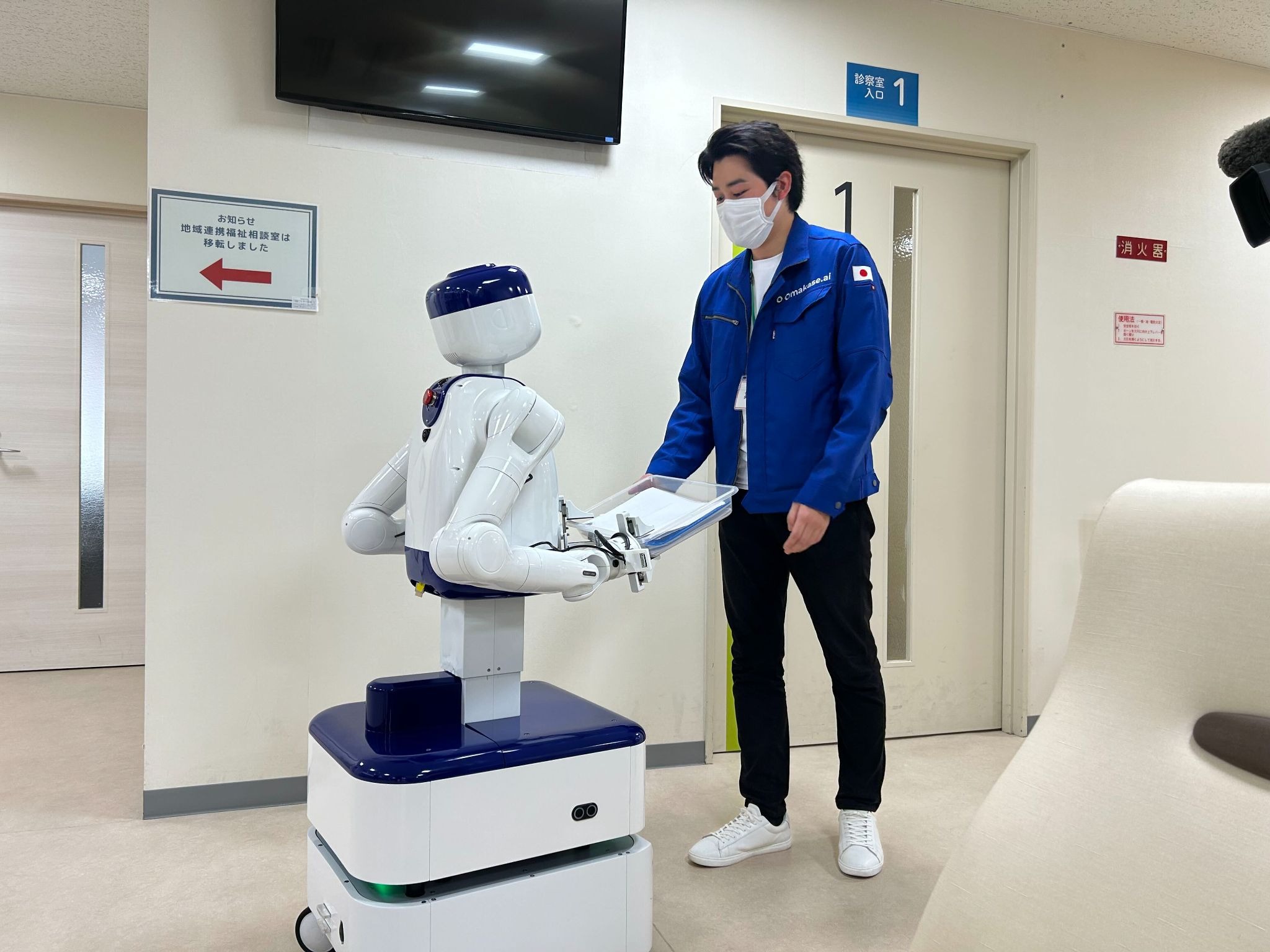
On staff instruction, D1 carried light items such as hospital documents among exam rooms, the health screening center, and the community welfare consultation office. That document run is daily work, and D1 was tested on it to cut the time staff spend on it.

D1 understood spoken instructions and went to the named location. The test was not only walking there. It included holding the items and handing them over at the destination.

What was tested

  • Understanding spoken transport requests

  • Moving among exam rooms, the health screening center, and the community welfare office

  • Holding and carrying light items such as hospital documents

  • Handing items over at the named place or to a named staff member

  • Combining guidance and light transport in one run

Result: The full sequence, from the spoken request through autonomous travel and handoff, was completed.

3. Preparing tea at a tea dispenser
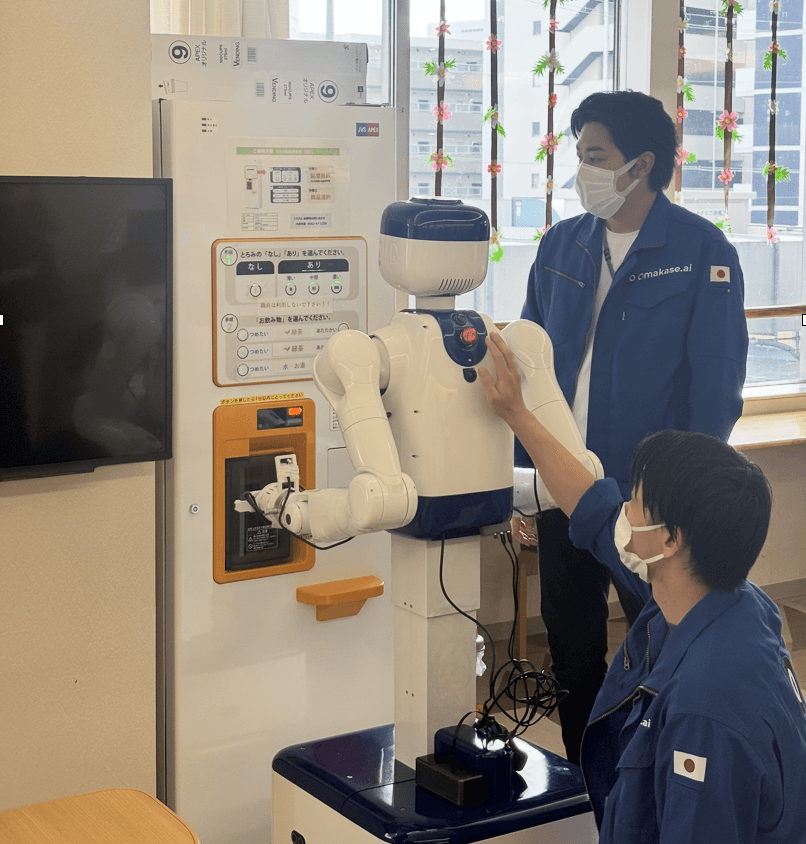
In a ward dayroom, D1 used a tea dispenser to prepare tea with or without thickener, and at the requested strength. Matching thickener to each patient takes staff time. D1 was tested on the dispenser to reduce that work.

D1 tried choosing the right buttons by reading labels on the panel, such as no thickener, thin, medium, and thick, and by following spoken instructions.

This task mixes reading and listening with fine two-arm positioning on a machine, so it was run with remote control. Button-press motion was recorded at the same time, for later work on autonomy.

What was tested

  • Choosing and pressing buttons by reading the panel

  • Choosing and pressing buttons from spoken instructions

  • Announcing by voice when the operation was done

Result: The planned steps were completed, and field data was collected to improve autonomy.

4. Tray clearing support
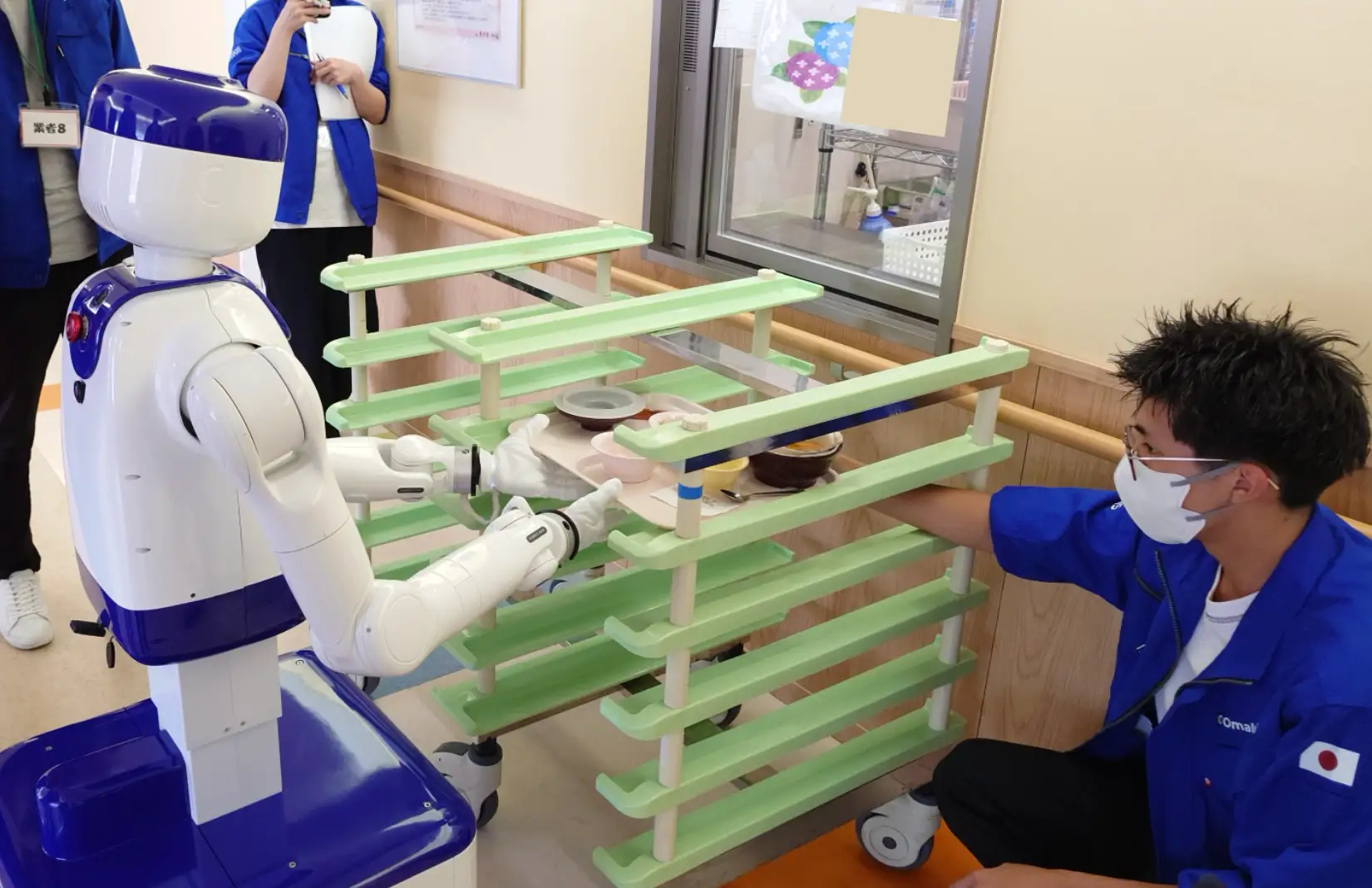
The trial covered clearing trays after a meal and loading them onto a cart. In hospitals, clearing takes as much time as serving, especially checking and recording how much food is left. D1 was tested on that sequence as tray-clearing support.

D1 picked up a tray with dishes on it, kept it level while moving to the cart, and tried placing it on the cart.

A camera and a multimodal model were also used to estimate leftovers, such as rice and side dishes. The longer-term aim is to help staff see what patients ate and to ease the checking and charting that follows.

Picking up a loaded tray, keeping it level, and setting it on a cart all need high precision, so the trial used remote control and other safety measures.

What was tested

  • Collecting trays with dishes on them

  • Moving while keeping the tray level

  • Loading trays onto a cart

  • Estimating leftovers with multimodal AI

Result: The planned steps were completed, and field data was collected to improve autonomy.

5. Leading exercise
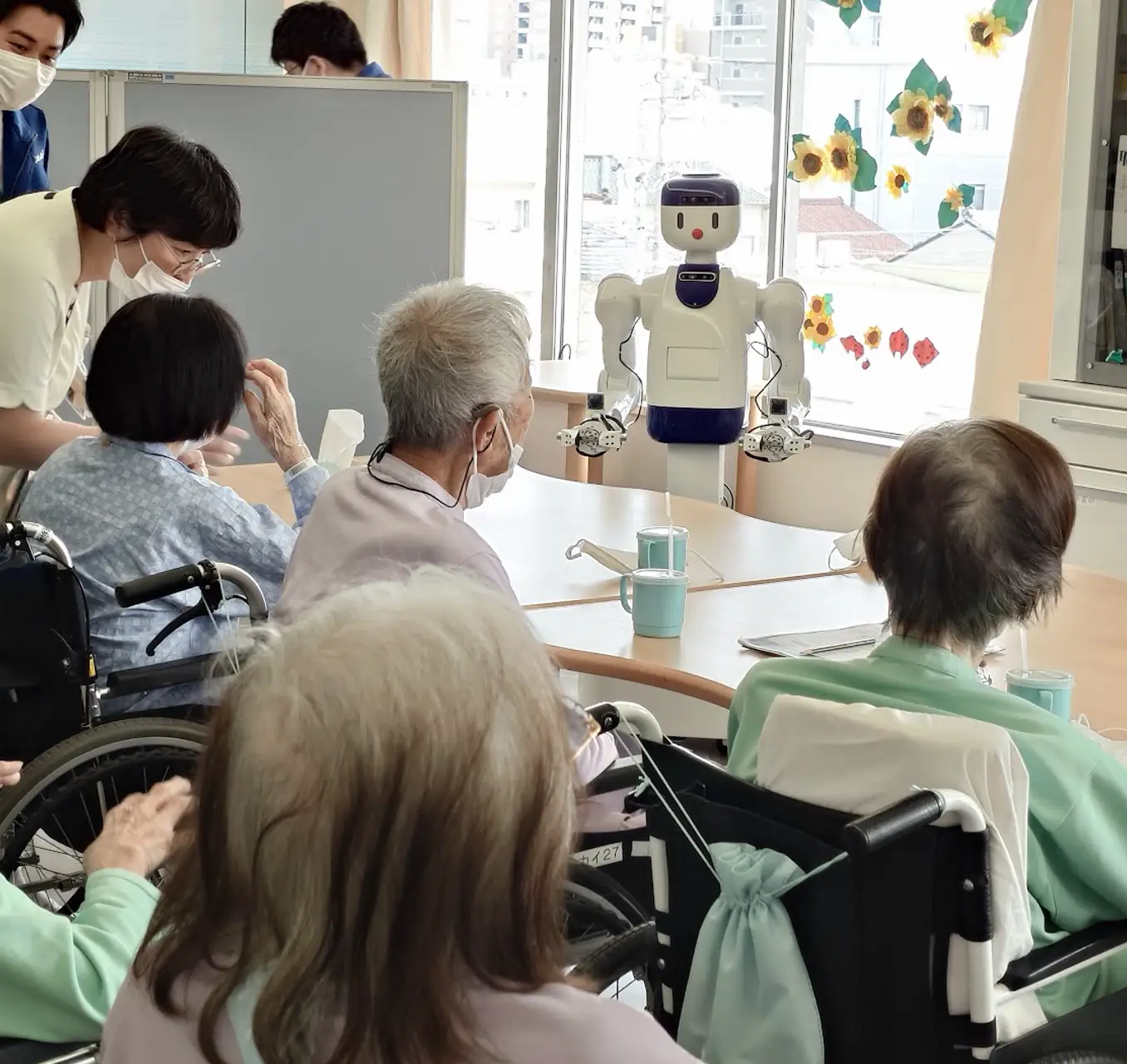
D1 led exercise with patients as a form of recreation support. Ward exercise and recreation are usually run by nurses and nursing assistants. D1 was tested on leading that session to ease that work.

D1 used its arms and body for several exercise moves. Patients followed along by watching D1. Speed and range were adjusted so patients could copy the motion.

The longer-term aim is more recreation in wards and dayrooms, with less of that work falling on clinical staff.

The session was run at a safe distance, with no physical contact, and with safety measures in place.

What was tested

  • Performing exercise moves with the arms and body

  • Finding a speed and range patients can follow

  • Running several moves in a row

  • Whether this works as recreation done together with patients

Result: D1 completed the planned exercise with patients, showing it could help with recreation.

4. Findings and Next Steps

Two D1 units ran a combined 35 hours over three days. In a working hospital, they were able to take on five different tasks: reception and guidance, light transport, tea service, tray clearing, and leading exercise.

Hours on site were 12 on day one, 16 on day two, and 7 on day three, for 35 hours in total.

On reception, guidance, and light transport, D1 used spoken instructions and live camera and sensor data, watched for people and obstacles, and still reached its destinations. Completing guidance and transport that way is an important step toward putting D1 to work.

On tea service and tray clearing, D1 used both arms for button presses, gripping and carrying trays, and loading a cart. Because the equipment and objects were the ones the hospital actually uses, the trial produced field data that a lab cannot.

Two-arm work still needs more precision before it can run on its own, including where to grip, how much force to use, how repeatable the machine operation is, and how to keep it safe.

ZEALS will keep collecting field data, including from this trial, and will use it to train, evaluate, and improve its models. Autonomy and accuracy on manipulation tasks, starting with tea service and tray clearing, will be raised in stages.

Staff also said that as the workforce shrinks, they want work that does not have to be done by clinicians to go to someone else. ZEALS will take that into improvements on D1 and into how it is operated.

This proof of concept did more than show that D1 can function. It made concrete which hospital tasks a humanoid can take on, and which problems still have to be solved before everyday use.

Comment from Hospital Director Kazutoshi Kurokouchi

"As the working-age population shrinks, hospitals already have a chronic staff shortage, and it is only going to get worse. That is why I believe we will need robots to help fill the gap.

We do not want robots to take clinicians' jobs. If they cover the shortage, clinicians can spend more time with patients and on the work that makes patients feel well cared for. That would be ideal.

The robot's own safety matters, of course. I also think filling the shortage can make the whole hospital safer. This kind of use may add value for the hospital as well. Juko Osu Hospital wants to stay involved in robot development."

Kazutoshi Kurokouchi
Director, Juko Osu Hospital, Keimeikai Medical Corporation

■About D1
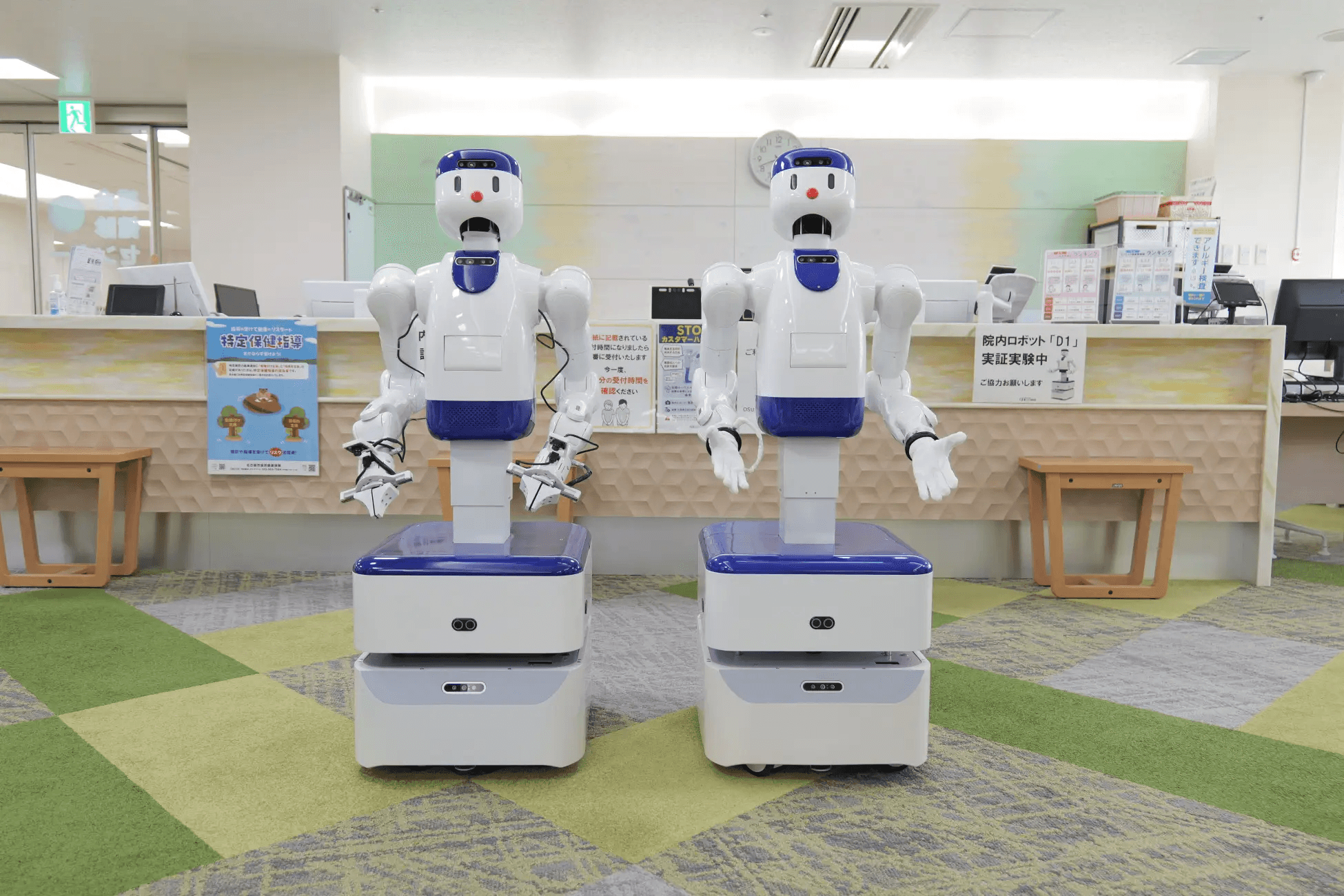
D1 is a compact humanoid built in Japan, designed to share indoor space with people and to take on specific tasks.

ZEALS sources parts and technology worldwide, and leads in Japan on AI, software, control, assembly, and how the robot is introduced and run on site.

D1 stands about 129.3 cm tall, with a mobile base about 48 cm wide. It is being built for natural conversation, reception and guidance, autonomous navigation, obstacle avoidance, and multiple languages, and is being extended into physical work such as preparing supplies, carrying items, and handing them over with two arms.

Pricing is planned to start at JPY 5 million per unit. Sales inquiries opened on August 5, 2026.

■D1 site: https://www.omakaserobotics.ai/en

■About Juko Osu Hospital

Juko Osu Hospital, in Naka-ku, Nagoya, offers outpatient care, inpatient care, health screenings, testing, and rehabilitation.

It opened as Juko Osu Hospital in January 2024, after Juko Memorial Hospital and Osu Hospital merged. It is a regional hospital covering acute care through post-acute rehabilitation, and it also runs emergency care 24 hours a day, 365 days a year.

Operator: Keimeikai Medical Corporation
Hospital: Juko Osu Hospital
Address: 2-17-5 Matsubara, Naka-ku, Nagoya, Aichi
Beds: 250
Website: https://juko-osu-hp.jp/

■About CUC Inc.

Company name: CUC Inc.
Founded: August 8, 2014
Address: 15F, msb Tamachi Tamachi Station Tower N, 3-1-1 Shibaura, Minato-ku, Tokyo
Representative: Keita Hamaguchi, Representative Director
Business: Management support for hospitals, hospice care, home-visit nursing, and related services
Website: https://www.cuc-jpn.com/

■About ZEALS

Company name: ZEALS Co., Ltd.
Founded: April 1, 2014
Capital: JPY 100 million
Address: 6F Arco Tower, 1-8-1 Shimomeguro, Meguro-ku, Tokyo
Representative: Masa, Founder and CEO
Business: Omakase AI, Omakase OS, ZEALS AI Agent, and related products
Website: https://zeals.ai/en/
D1 site: https://www.omakaserobotics.ai/en

News

ZEALS Partners with Timee to Build Spot Work for Physical AI Data Collection

The two companies will design spot work, single-shift jobs booked on demand, for collecting real-world data for physical AI, a field already growing quickly in the United States and China.

ZEALS, the developer of D1, a compact humanoid robot built in Japan, has partnered with Timee, Inc., which operates Timee, a platform for spot work. Together, they aim to create a new category of work for the physical AI era: data-collection spot work.

Data-collection spot work is short-term work that gathers and organizes the real-world data required for physical AI to learn and improve. The scope and intended use of the data collected are stated explicitly, and the work is designed around safety, quality, and privacy protection.

ZEALS is deploying humanoids such as D1 in real workplaces. Timee has spent years matching workers to on-site jobs. Together they will explore new forms of work that support physical AI as it moves into the field.

Background

Generative AI has spread quickly through digital work: text, images, and audio.

Physical AI is different. Robots and humanoids that act among people, objects, and physical spaces need more than internet data. They need records of physical work: how people hold things, in what order they do a task, how they judge a situation, and what they do when something unexpected happens.

That kind of context does not exist on the web. It has to be collected on site, organized, and then used to train and improve models.

In the United States and China, companies are already emerging around this work: collecting real-world data, remote operation, human demonstration, annotation, and quality control for physical AI and robotics foundation models. As physical AI reaches Japanese workplaces, systems that support this kind of ongoing work are expected to become increasingly important in Japan.

On August 5, 2026, ZEALS launched D1, a compact humanoid built in Japan. The company plans to produce 100 units in fiscal 2026 and reach 10,000 cumulative hours on site. Deployment will begin in healthcare and elder care, followed by manufacturing, logistics, and hotels.

For D1 and other humanoids to keep working after they are installed, each site's tasks, the way people move and decide, and how exceptions are handled have to be captured as data and fed back into learning, evaluation, and improvement.

The two companies formed the partnership to turn that process into paid work that uses people's judgment and field experience, so physical AI can advance and new jobs can appear at the same time.

Roles

ZEALS will start from the field: what physical AI needs to learn, and what data that requires. It will set the requirements for collection and sort out the extra work that appears when a robot is installed.

Timee will use its experience turning on-site work into jobs people can take. It will focus on recruiting, matching, shift design, and on-site operations.

Scope of the Partnership

1. Designing data-collection spot work for physical AI

The companies will design work that collects and organizes procedures, motion, the environment, human judgment and assistance, and exception handling, so humanoid robots can learn and improve.

Examples may include reception and wayfinding in a building, handing over items, and staff demonstrating how a task is performed, all collected as spot work.

2. Operations that protect workers and ensure data quality

Training data for physical AI must meet a consistent standard to be usable.

The two companies will split roles clearly and design how the work runs, including procedures, training, safety, quality checks, and how results are shared, so spot workers can take part with confidence. What is collected, and why, will be stated in advance. Privacy measures such as anonymization and masking will be used where they are needed.

3. Spot workers around robot installation and day-to-day operation

Beyond data collection, the companies will explore using spot workers when humanoids such as D1 are installed at a company or facility: helping with delivery and setup, support in the first days of operation, helping users, checking how the robot is running, and reporting from the site.

A humanoid's value in the field is not only the hardware. It also depends on running the robot after it arrives and improving it over time. The partnership will treat the new tasks that come with that as jobs the physical AI era can create.

Outlook

ZEALS does not see AI and robots only as replacements for existing jobs. As they improve, they can also create new work.

As physical AI enters real sites, tasks that did not exist before are likely to appear: collecting data, setup, operations support, quality checks, and feeding results back into the next version.

People's judgment and field experience can help physical AI get better, and that help can be paid work. With Timee, ZEALS aims to build that into a new job category for a period in which people and machines work side by side.

The work will not stop at data collection. It will extend to the other jobs that show up around physical AI, including bringing robots in, setting them up, and keeping them running.

About D1

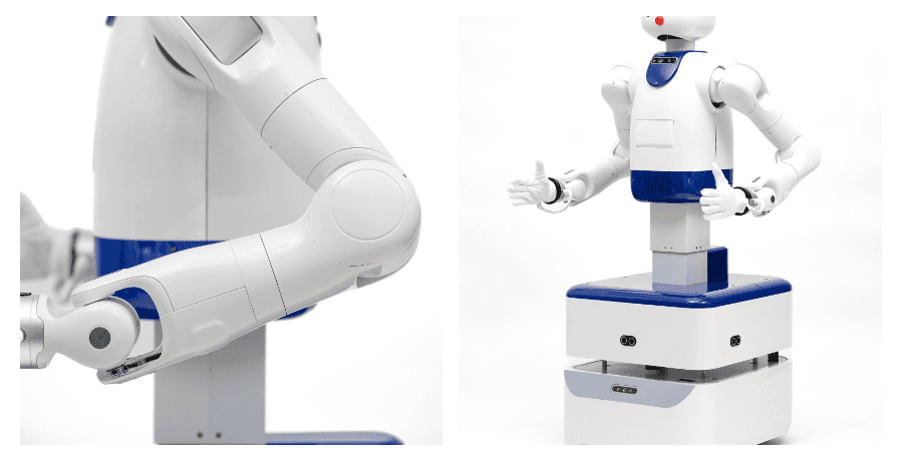
D1 is a compact humanoid built in Japan, made to share indoor space with people and to take on specific tasks.

ZEALS sources parts and technology worldwide, and leads in Japan on AI, software, control, assembly, and how the robot is introduced and run on site.

D1 is compact enough for Japanese interiors. It is built for conversation, guidance, movement, multiple languages, and two-armed task support.

It was launched on August 5, 2026. Inquiries and sales opened at a starting price of JPY 5 million per unit. ZEALS plans 100 units in fiscal 2026 and 10,000 cumulative hours on site, in healthcare and elder care, manufacturing and logistics, hotels, and other places short of staff.

D1 site: https://omakaserobotics.ai/en
About Timee

Company name: Timee, Inc.
Founded: August 2017
Capital: JPY 3.88 billion (as of October 2025, including capital reserve)
Address: 35F Shiodome City Center, 1-5-2 Higashi-Shimbashi, Minato-ku, Tokyo
Representative: Ryo Ogawa, Representative Director
Business: Planning, development, and operation of applications
Website: https://corp.timee.co.jp/

About ZEALS

Company name: ZEALS Co., Ltd.
Founded: April 1, 2014
Capital: JPY 100 million
Address: 6F Arco Tower, 1-8-1 Shimomeguro, Meguro-ku, Tokyo
Representative: Masa, Founder and CEO
Business: Omakase AI, D1, Omakase Zen, Omakase OS, ZEALS AI Agent, and related products
Website: https://zeals.ai/en/
D1 site: https://omakaserobotics.ai/en
News

ZEALS Demonstrates D1 at CITRIS, UC Berkeley, and Opens Talks on R&D Collaboration

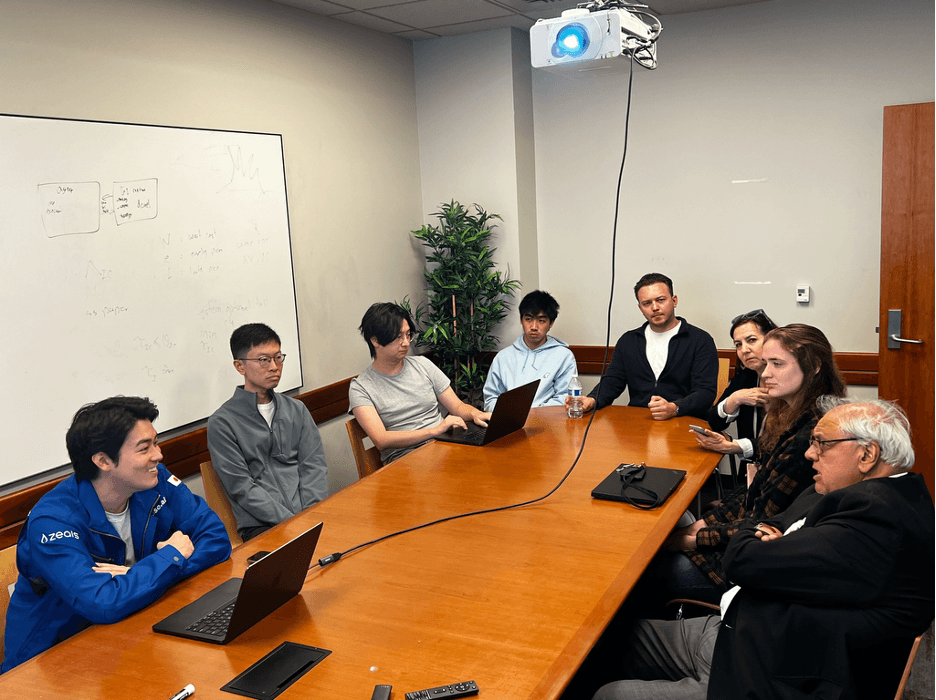
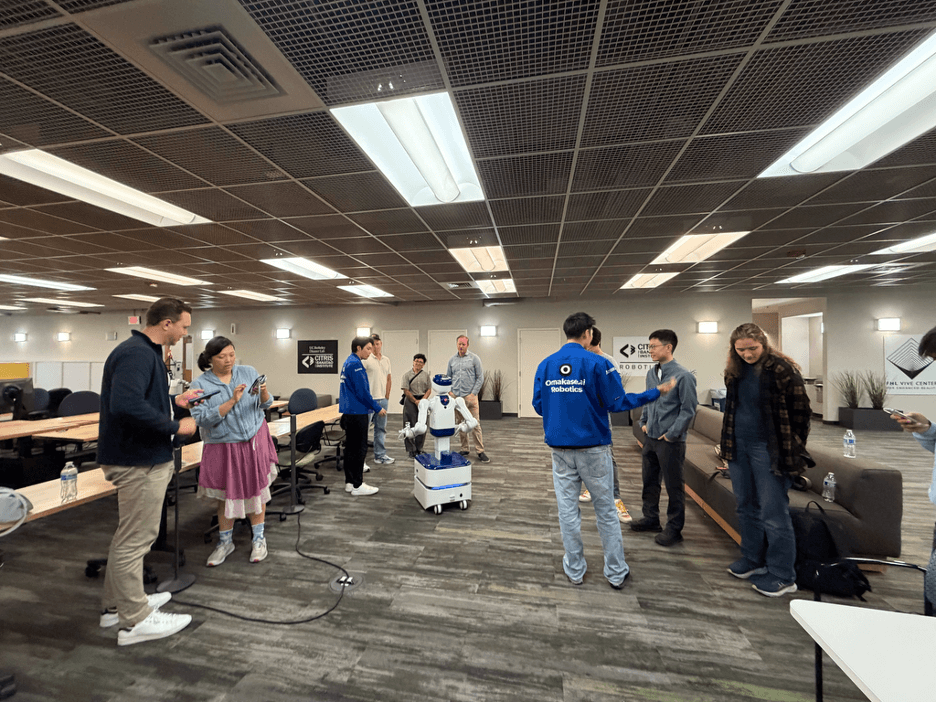
On August 12, 2026, ZEALS brought its compact humanoid D1 to CITRIS and the Banatao Institute at UC Berkeley for a presentation and live demonstration. The team transported the robot to campus and ran the session in the CITRIS Robotics Lab at Sutardja Dai Hall.

The visit was hosted by Julie Shapiro, Director of Corporate Relations at CITRIS. Professor S. Shankar Sastry of UC Berkeley EECS, a former Director of CITRIS, joined the session, as did Jolie Lam, CITRIS Program Director for Surgical Robotics and Health Data Science & AI for Medicine, and Dan Chapman, curator of the CITRIS Tech Museum, along with CITRIS staff and students.

ZEALS opened by introducing Omakase Robotics and D1, and described the work D1 already handles in healthcare settings in Japan. A live demonstration followed, and the two sides exchanged views on the robotics research underway at CITRIS.

D1 also met BRETT, the Berkeley Robot for the Elimination of Tedious Tasks, a robot long associated with Berkeley's work on robot learning.

Both teams found a good deal of overlap in their respective work, discussed where an R&D collaboration could make sense, and agreed to continue the conversation.

ZEALS, led in the U.S. by COO Matt Laker, will keep working with research institutions to advance the real-world deployment of humanoid robots that understand their surroundings and take on the right roles alongside people.

News

ZEALS Unveils Japan-Built Compact Humanoid D1 in the U.S., Drawing 100+ Researchers from Stanford, UC Berkeley, Google DeepMind, NVIDIA and OpenAI

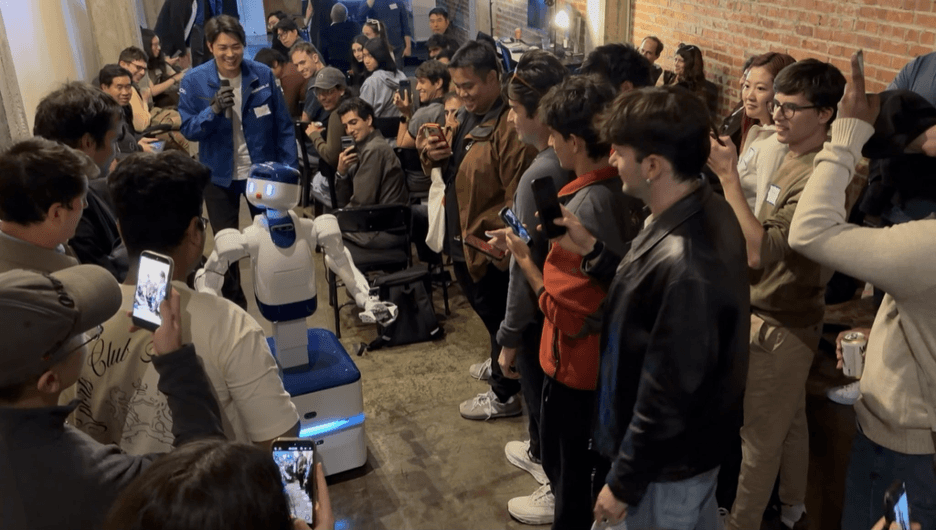
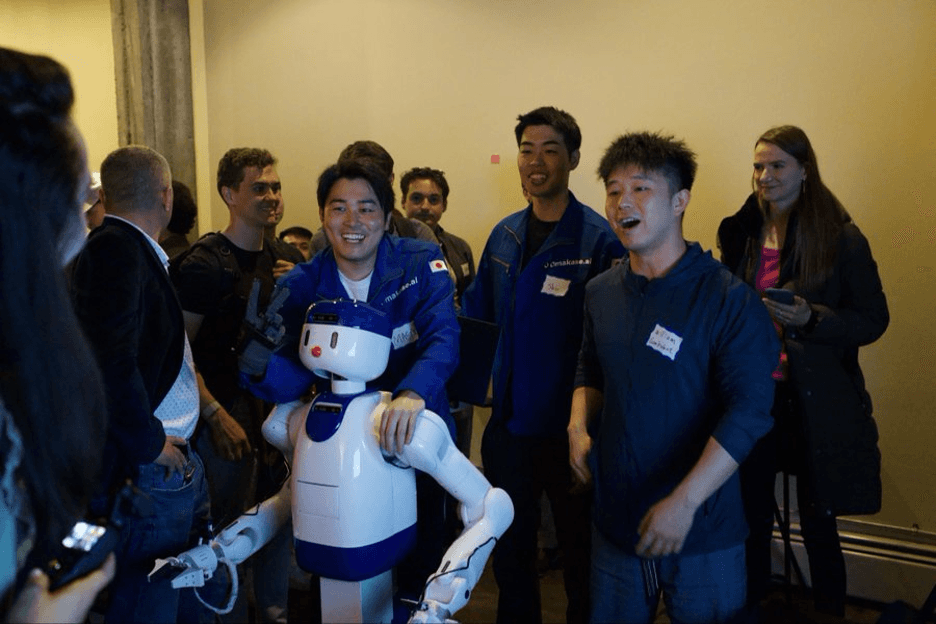
On August 11, 2026, ZEALS held Robots & Sake, the U.S. launch party for D1, its compact humanoid built in Japan, at 164 Townsend Street in San Francisco. Sign-ups passed 200 and more than 100 guests came over the course of the evening. D1 worked the floor itself, greeting arrivals and demonstrating the hospitality tasks it already performs at deployment sites in Japan.

The event paired robotics research with sake. Japanese snacks and sake were served, and after a demo from D1 and a panel discussion, the rest of the evening was given over to networking.

The sign-up list was made up of the people building physical AI in the United States. Stanford and UC Berkeley each accounted for 20 or more sign-ups from their flagship robotics labs. The Intelligent Robotics Group at NASA Ames, Physical Intelligence, Google DeepMind, NVIDIA, OpenAI, xAI, Microsoft Research, and Amazon were also on the list.

D1 also ran a navigation demo at the venue. Asked by a guest where the restroom was, it led them there and made its own way back through the crowded room.

The Reveal and the Panel

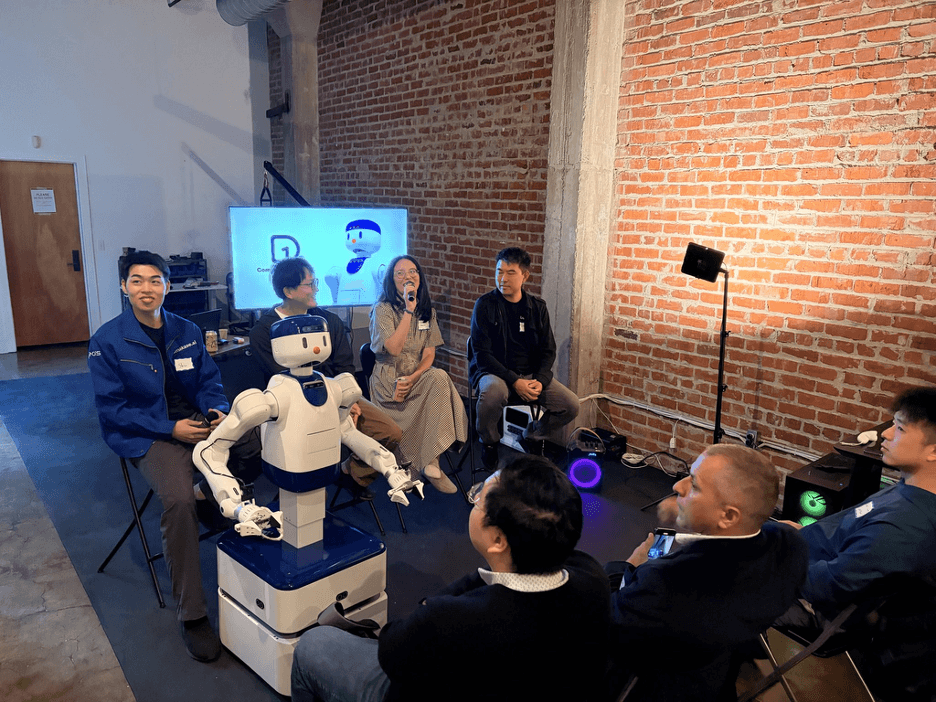
ZEALS Founder and CEO Masa Shimizu took the stage and revealed D1 in a program hosted by COO Matt Laker. Masa also described the company's plan to bring humanoids built in Japan to hospitals, hotels, and commercial spaces in the United States.

CTO Shu Nagao then moderated a panel with three people working on physical AI: Vivian Feig, Assistant Professor of Mechanical Engineering at Stanford University; Takahiro Miki, Research Scientist at Google DeepMind; and David Chen, GM of Robotics at LiveKit.

The 20-minute discussion centered on the gap between the lab and the field: what it takes to deploy research at a real site, whether Japan really has an edge in operational data, what kind of data labs need to move their work forward, and what is still missing on the hardware side.

News

ZEALS Appoints Former Minister of Justice Hideki Makihara as Advisor to Its Robotics Business

ZEALS Corporation (“ZEALS”; headquarters: Meguro-ku, Tokyo; Representative Director: Masahiro Shimizu), developer of the quasi-domestically produced compact humanoid robot D1, is pleased to announce the appointment of former Minister of Justice Hideki Makihara as an advisor to the company’s robotics business, centered on D1.

Background to the Appointment

Japan is facing increasingly severe labor shortages across a wide range of sectors, including healthcare and nursing care, hospitality, logistics, and manufacturing, driven by the declining birthrate, aging population, and shrinking working-age population.

Against this backdrop, expectations are growing for “Physical AI”—AI that extends beyond the digital realm to perceive and interact with the physical world through robots, enabling them to move, communicate, and perform tasks.

ZEALS has been expanding the technologies and expertise it has developed through the creation and real-world deployment of customer service AI agents into the physical world. Through its initiatives in robotics, the company aims to build a society in which AI and robots work alongside people.

On August 5, 2026, ZEALS officially unveiled D1, a quasi-domestically produced compact humanoid robot developed specifically for use in Japan’s indoor environments.

Press release: https://prtimes.jp/main/html/rd/p/000000206.000019209.html

D1 is designed to operate in the environments commonly found in Japanese hospitals, nursing care facilities, hotels, logistics facilities, and manufacturing sites, including narrow corridors and doorways, elevators, reception areas, waiting rooms, and back-of-house spaces.

For robots to advance beyond the research and development stage and become continuously utilized in real-world settings, it is essential to focus not only on developing the robot hardware and AI, but also on ensuring that deployment is aligned with society, existing regulatory frameworks, and the operational requirements of each implementation site.

By welcoming Mr. Makihara—who brings extensive knowledge and experience in legal practice, public administration, economic and industrial policy, and health, labor, and welfare—as an advisor, ZEALS will further strengthen the organization driving its robotics business centered on D1.

About the Quasi-Domestically Produced Compact Humanoid Robot D1

D1 is a quasi-domestically produced compact humanoid robot developed for practical use in Japan’s indoor environments.

Standing approximately 129.3 centimeters tall, with a mobile base measuring approximately 48 centimeters in width, D1 features a compact design that enables it to navigate the narrow corridors, doorways, and elevators commonly found in Japanese buildings. It is designed to perform a wide range of tasks while communicating with people, including providing guidance and reception services, conducting patrols, monitoring people’s well-being, and transporting and handing over items.

In addition to providing the robot itself, ZEALS will work closely with client companies and partners to design on-site workflows and establish operational systems that enable the robot to deliver sustainable value over time.

Profile of Hideki Makihara

President and Representative Director, Dream Platform Inc.

Former Minister of Justice and former Member of the House of Representatives

Former State Minister of Economy, Trade and Industry; former State Minister of Health, Labour and Welfare; and former Parliamentary Vice-Minister of the Environment

After graduating from Azabu High School and the Faculty of Law at the University of Tokyo, Mr. Makihara worked as an attorney on numerous international matters. He subsequently studied at Georgetown University Law Center and practiced as an attorney qualified in both Japan and the State of New York.

In 2003, he joined Japan’s Ministry of Economy, Trade and Industry, where he achieved notable successes in international trade negotiations. He was first elected to the House of Representatives in 2005. Throughout his career, he has advanced policies across a broad range of fields, including justice, the economy, and health, labor, and welfare, while playing a leading role in reforming Japan’s legal system and shaping its international economic policy.

Message from Hideki Makihara

As Japan faces an accelerating population decline and increasingly severe labor shortages, building a society in which people and technology work together through the use of AI and robotics is an issue of critical importance.

I see D1, developed by ZEALS, as an ambitious initiative that directly addresses the characteristics of Japanese buildings and workplaces, with the clear goal of achieving practical, real-world adoption.

For new technologies to gain broad acceptance in society, technological advancement alone is not enough. It is equally important to deploy them thoughtfully and carefully, ensuring harmony with existing systems, the workplaces in which they are introduced, and people’s everyday lives.

Drawing on my experience in law, public administration, and industrial policy, I look forward to contributing to the real-world deployment of D1 and the development of a Physical AI industry originating in Japan.

News

ZEALS Launches Compact Humanoid "D1”, Built in 🇯🇵

ZEALS today announced the official launch of D1, a compact humanoid built in Japan optimized for indoor environments in Japan, on Wednesday, August 5, 2026.

D1 sales website: https://www.omakaserobotics.ai
Concept video: https://youtu.be/YOuuikhMkuA

D1 is a humanoid designed for a wide range of indoor settings, including healthcare and elder-care facilities, manufacturing and logistics sites, and hotels. In addition to AI-enabled natural dialogue, reception and guidance, navigation, and multilingual support, D1 helps workplaces facing severe labor shortages through item transport and task assistance using its two arms. Pricing is planned to start at JPY 5 million per unit, and consultations and sales inquiries open today, August 5.

ZEALS views not simply the number of units sold, but the number of hours robots actually perform work in the field, as its most important metric for real-world deployment. The company aims to produce 100 units within fiscal year 2026 and achieve a cumulative 10,000 operational hours, accelerating expansion from healthcare into diverse industries.

ZEALS will also work closely with partners in four areas—healthcare, insurance, leasing, and deployment—to build a robust ecosystem that supports D1 from use-case creation and risk management to financing and operational support, enabling it to work independently in real workplaces.

Background: From a Country at the Forefront of Challenges to a Country at the Forefront of Humanoid Use Cases

Japan is experiencing increasingly serious labor shortages across healthcare, elder care, manufacturing, logistics, hotels, and many other settings. Combining AI and robotics can create new solutions for some of the work people have traditionally performed, including reception, guidance, patrols, preparation of supplies, transport, and meal-service assistance.

While humanoids are attracting global attention, it is still not clearly established which workplaces and tasks they will serve, or how they should be operated and improved after deployment.

For humanoids to become established as real members of the workforce, they must adapt to the distinct spaces and operating procedures of each site, while continuing to collect data, learn, evaluate, and improve after deployment.

Rather than launching D1 across many industries at once, ZEALS will pursue real-world deployment beginning with specific tasks that have clear challenges and ongoing demand. By creating reliable operation in one workplace and one task at a time, ZEALS will progressively extend the learning data and operational know-how gained there to other sites with similar challenges.

Japan concentrates many of the challenges humanoids must address to become practical: an aging and shrinking population, labor shortages, high expectations for service quality, constrained indoor spaces, and complex operating procedures. ZEALS sees Japan not only as a country at the forefront of challenges, but as a market capable of becoming a leader in use cases where humanoids perform real work.

Why We Begin with ‘Semi-Domestic’ in a Country at the Forefront of Challenges

D1 begins deliberately as ‘semi-domestic,’ rather than a fully domestically produced robot with every part sourced in Japan. Insisting on full domestic production today could drive costs too high and limit access to world-class technology and components, slowing the pace of humanoid deployment in Japan, where labor shortages are an urgent challenge.

For D1, ZEALS will incorporate leading global components and technologies while taking the lead in Japan on AI, software, control, assembly, and deployment and operation tailored to Japanese workplaces. The first priority is to balance world-class performance with a realistic adoption price and increase the number of humanoids working in real settings.

Ultimately, ZEALS aims to create a fully domestically produced humanoid originating in Japan. Drawing on field data and operational know-how gained through D1’s deployment, the company will work with domestic component manufacturers, production partners, and research institutions to progressively localize key components.

Starting as ‘semi-domestic’ to accelerate real-world deployment with leading global technology, ZEALS will develop technology and manufacturing capabilities together with Japanese suppliers and advance toward a fully domestically produced humanoid that can compete globally. D1 will serve as the starting point for that journey.

About D1, the Compact Humanoid

D1 is a ‘semi-domestic’ compact humanoid developed to coexist with people in Japanese indoor spaces and carry out specific tasks.

Hospitals, elder-care facilities, manufacturing and logistics sites, and hotels in Japan require robots that can move and operate safely amid narrow corridors, elevators, existing equipment and furnishings, and the flow of people.

D1 was developed with a focus on a size, price point, operability, and safety profile that make it easy to introduce into workplaces, as well as natural interaction with people.

D1 is not limited to dialogue and guidance. As a two-armed humanoid, it will expand into physical work support such as preparing supplies, assisting with meal service, weighing, transporting, and handing over items.

D1 has four key features:

1. World-Class Technology at a Starting Price of JPY 5 Million per Unit

By incorporating world-class technologies and components, D1 will be available from JPY 5 million per unit.

To move humanoids beyond research, development, and demonstrations into sustained operation in real work, it is essential to keep the price within reach for workplaces considering adoption.

However, keeping down the cost of the hardware alone is not enough for D1’s real-world deployment.

A system is also needed to support ongoing operation after adoption, including selecting the right tasks, adapting to the workplace environment, collecting data, training models, designing operations, maintenance, and preparing for potential risks.

Through collaboration with insurance and leasing partners and post-deployment operational support, ZEALS will create an environment where companies and facilities can introduce and continue using D1.

2. Compact Design: Approx. 129.3 cm Tall with a 48 cm-Wide Mobile Base

D1 is designed as a compact humanoid approximately 129.3 cm tall for use in Japanese buildings and indoor spaces.

With its mobile base kept to approximately 48 cm wide, it is designed for practical operation in typical Japanese indoor settings such as hospitals, hotels, and offices.

This compact design accounts for Japan’s built environment—limited corridor widths, doors, and elevators—and aims to create Physical AI that can coexist naturally with people and operate continuously in the same space.

Some overseas humanoids are human-sized or have large bodies, with use cases designed for spacious or dedicated environments.

In Japan’s indoor workplaces, however, it is important to be able to introduce robots directly into existing corridors, reception counters, waiting areas, elevators, back-of-house spaces, and factory work areas.

D1 is intended to enter existing indoor spaces in Japan without requiring major facility changes or robot-only environments, performing dialogue, movement, guidance, patrols, transport, and task assistance.
*Approximately 48 cm refers to the width of the mobile base.

3. Designed for Safe, Long-Hour Operation in Indoor Spaces Shared with People

D1 is developed with safety and operability in mind for long hours of use in indoor spaces shared with people.

Hospitals, elder-care facilities, and hotels are shared by diverse groups including older adults, patients, visitors, guests, and staff. Manufacturing and logistics sites likewise require safe operation amid workers, equipment, and transported goods.

D1 is being equipped with torque sensors on every joint of its arms so it can detect contact with people or objects and stop movement. Its controls are also being advanced to detect people and obstacles while moving, and to operate at safe speeds along safe paths.

D1 includes a battery capable of operating for up to approximately eight hours, helping to minimize work interruptions for charging while supporting long-duration tasks such as reception, guidance, patrols, and transport. By combining safety with an operating time that can be integrated into real shifts and workflows, ZEALS aims to build a humanoid that can be used continuously.

In a prior proof of concept at University of Tsukuba Hospital, D1 completed validation in conditions close to a real hospital indoor environment with zero human contact and zero falls.

ZEALS will continue testing in real workplaces and establish a risk-management framework with insurance partners so companies and facilities can introduce and operate D1 with confidence.

4. Human Interaction Powered by AI Communication Expertise

D1 is a humanoid that emphasizes engaging naturally with people, not merely moving or carrying out tasks.

Drawing on ZEALS’ experience in AI customer service, AI agents, and AI avatars, D1 will advance real-world deployment from tasks involving human interaction, including natural dialogue, reception service, guidance, proactive communication, and multilingual support.

In healthcare and elder care, anticipated uses include guidance for patients and visitors, responding to inquiries, speaking with people while they wait, supporting older adults, and assisting with exercise and recreation.

In hotels, anticipated uses include guest guidance, in-building navigation, responding to inquiries, and multilingual communication.

In manufacturing and logistics as well, the ability to exchange information with people on site—for guidance, confirmation, reporting, and notifications when anomalies occur—is important.

Starting from dialogue with people, D1 will broaden the range of tasks it can support to physical work involving its two arms, including handing over items, meal service, preparing supplies, transport, weighing, and task assistance.

Accelerating D1’s Real-World Deployment with Partners in Four Areas

Deploying D1 requires more than robot development: it requires task adaptation, risk preparedness, financial support, and a workplace deployment and operations framework.

ZEALS is building an integrated support structure with partners in healthcare, insurance, leasing, and deployment, from use-case design through operational improvement.

Message from the CEO ZEALS Inc.

Representative Director and CEO Masahiro Shimizu

I currently spend roughly ten days a month in China, ten days in the United States, and ten days in Japan, seeing the evolution of cutting-edge Physical AI and humanoids firsthand. The United States and China lead the world in the scale of technology development and investment. Yet seeing the world has made me certain of Japan’s winning path: creating, ahead of the rest of the world, use cases in which humanoids do real work.

Japan concentrates the conditions and challenges needed to make humanoids practical: an aging and shrinking population, labor shortages, high expectations for service quality, complex operations, and limited indoor spaces. Precisely because Japan is at the forefront of these challenges, I believe it can become a leader in humanoid use cases.

D1 was developed not for laboratories or trade shows, but by working backward from what it takes to operate in real Japanese workplaces. It combines a starting price of JPY 5 million per unit, a compact design suited to Japanese indoor spaces, and human interaction that enables natural dialogue.

Our goal is not to deliver D1, but to keep it working continuously in real tasks. We will enter workplaces, gather data, learn, improve movement and operations, and create the conditions for D1 to continue working alongside people. We will begin by going deep into specific settings such as healthcare and elder care, advancing deployment steadily.

D1 deliberately begins as ‘semi-domestic.’ We will incorporate the world’s leading technologies and components while advancing AI, software, control, assembly, and deployment under Japanese leadership. This choice enables us to ensure safety and reliability in workplaces at speed. By designing and managing D1 from Japan, we can precisely implement the safety functions needed to work in spaces shared with people, while balancing world-class performance and an adoptable price.

First, we will build knowledge in Japanese workplaces and accumulate practical use cases and operational know-how ahead of the world. Then, together with Japanese suppliers, we will develop technology and manufacturing capacity and take humanoids born in Japan to workplaces around the world. Our ultimate goal is to create a fully domestically produced humanoid from Japan that can compete globally.

From Japan’s challenges, we will create a global standard. D1 is our first step.

News

ZEALS Exchanges Views on Physical AI with House of Councillors Member Taro Yamada, Secretary-General of the LDP Robot Parliamentarians’ League

ZEALS held an exchange of information and views on Physical AI with House of Councillors Member Taro Yamada, who serves as Secretary-General of the Liberal Democratic Party’s Robot Parliamentarians’ League.

The discussion covered domestic and international trends surrounding Physical AI and robotics, ZEALS’ robot development initiatives, and the potential for real-world deployment across industries including healthcare and elder care.

The participants also exchanged a broad range of views on strengthening Japan’s industrial competitiveness, creating the conditions needed for wider adoption of Physical AI, and the challenges ahead.

ZEALS will continue engaging in dialogue with relevant organizations and experts to advance the real-world deployment of Physical AI and contribute to the development of Japan-originated robotics.

News

ZEALS Conducts Japan’s First* Humanoid Robot Proof of Concept at University of Tsukuba Hospital

ZEALS, in collaboration with Quick Inc., a University of Tsukuba–originated startup, conducted a three-day proof of concept at University of Tsukuba Hospital from March 23 to 25, 2026, using the Unitree G1 humanoid robot.

The trial used a humanoid robot equipped with Omakase OS, ZEALS’ operating system for robotics, to evaluate autonomous walking, obstacle avoidance, conversational wayfinding, item transport, and anomaly detection within a hospital environment.

The proof of concept took place in the first-floor lobby of University of Tsukuba Hospital from 7:00 p.m. to 9:00 p.m., after outpatient services had ended. In a simulated real hospital environment, the team assessed stable bipedal walking on the floor, obstacle avoidance around traffic cones and pedestrians, and autonomous navigation to designated destinations.

The main results were as follows:

  • Stable bipedal walking on hospital flooring: Successful

  • Obstacle avoidance around traffic cones, pedestrians, and other objects: Successful

  • Autonomous walking to designated destinations: Successful

  • Conversational wayfinding and transport tasks: Successful

  • Anomaly detection: Successful

Although an incident temporarily interrupted power supply to peripheral equipment, all validation items were ultimately completed. The robot did not fall even once during the proof of concept, achieving stable operation in a hospital environment where safety is paramount.

On the final day, Hospital Director Yuji Hiramatsu and Assistant Hospital Director Kiyotaka Nemoto of University of Tsukuba Hospital attended a demonstration. The participants exchanged views on the potential of humanoid robots in healthcare settings, identifying further needs beyond wayfinding and transport, including support for a range of indirect tasks performed by healthcare professionals.

ZEALS will continue advancing the real-world deployment of humanoid robots that can understand their surroundings and perform appropriate roles alongside people, particularly in healthcare and other fields facing severe labor shortages.

*As of March 25, 2026, based on ZEALS research and publicly available information. This is the first case in Japan in which a general-purpose humanoid robot based on Unitree G1 has been tested in an in-hospital setting for autonomous bipedal walking, obstacle avoidance, conversational wayfinding, and transport tasks as an integrated set of capabilities.

© 2026 ZEALS Co., Ltd. All rights reserved.