

|
News
ZEALS today announced the official launch of D1, a compact humanoid built in Japan optimized for indoor environments in Japan, on Wednesday, August 5, 2026.
D1 sales website: https://www.omakaserobotics.ai
Concept video: https://youtu.be/YOuuikhMkuA
D1 is a humanoid designed for a wide range of indoor settings, including healthcare and elder-care facilities, manufacturing and logistics sites, and hotels. In addition to AI-enabled natural dialogue, reception and guidance, navigation, and multilingual support, D1 helps workplaces facing severe labor shortages through item transport and task assistance using its two arms. Pricing is planned to start at JPY 5 million per unit, and consultations and sales inquiries open today, August 5.
ZEALS views not simply the number of units sold, but the number of hours robots actually perform work in the field, as its most important metric for real-world deployment. The company aims to produce 100 units within fiscal year 2026 and achieve a cumulative 10,000 operational hours, accelerating expansion from healthcare into diverse industries.
ZEALS will also work closely with partners in four areas—healthcare, insurance, leasing, and deployment—to build a robust ecosystem that supports D1 from use-case creation and risk management to financing and operational support, enabling it to work independently in real workplaces.
Background: From a Country at the Forefront of Challenges to a Country at the Forefront of Humanoid Use Cases
Japan is experiencing increasingly serious labor shortages across healthcare, elder care, manufacturing, logistics, hotels, and many other settings. Combining AI and robotics can create new solutions for some of the work people have traditionally performed, including reception, guidance, patrols, preparation of supplies, transport, and meal-service assistance.
While humanoids are attracting global attention, it is still not clearly established which workplaces and tasks they will serve, or how they should be operated and improved after deployment.
For humanoids to become established as real members of the workforce, they must adapt to the distinct spaces and operating procedures of each site, while continuing to collect data, learn, evaluate, and improve after deployment.
Rather than launching D1 across many industries at once, ZEALS will pursue real-world deployment beginning with specific tasks that have clear challenges and ongoing demand. By creating reliable operation in one workplace and one task at a time, ZEALS will progressively extend the learning data and operational know-how gained there to other sites with similar challenges.
Japan concentrates many of the challenges humanoids must address to become practical: an aging and shrinking population, labor shortages, high expectations for service quality, constrained indoor spaces, and complex operating procedures. ZEALS sees Japan not only as a country at the forefront of challenges, but as a market capable of becoming a leader in use cases where humanoids perform real work.
Why We Begin with ‘Semi-Domestic’ in a Country at the Forefront of Challenges
D1 begins deliberately as ‘semi-domestic,’ rather than a fully domestically produced robot with every part sourced in Japan. Insisting on full domestic production today could drive costs too high and limit access to world-class technology and components, slowing the pace of humanoid deployment in Japan, where labor shortages are an urgent challenge.
For D1, ZEALS will incorporate leading global components and technologies while taking the lead in Japan on AI, software, control, assembly, and deployment and operation tailored to Japanese workplaces. The first priority is to balance world-class performance with a realistic adoption price and increase the number of humanoids working in real settings.
Ultimately, ZEALS aims to create a fully domestically produced humanoid originating in Japan. Drawing on field data and operational know-how gained through D1’s deployment, the company will work with domestic component manufacturers, production partners, and research institutions to progressively localize key components.
Starting as ‘semi-domestic’ to accelerate real-world deployment with leading global technology, ZEALS will develop technology and manufacturing capabilities together with Japanese suppliers and advance toward a fully domestically produced humanoid that can compete globally. D1 will serve as the starting point for that journey.
About D1, the Compact Humanoid
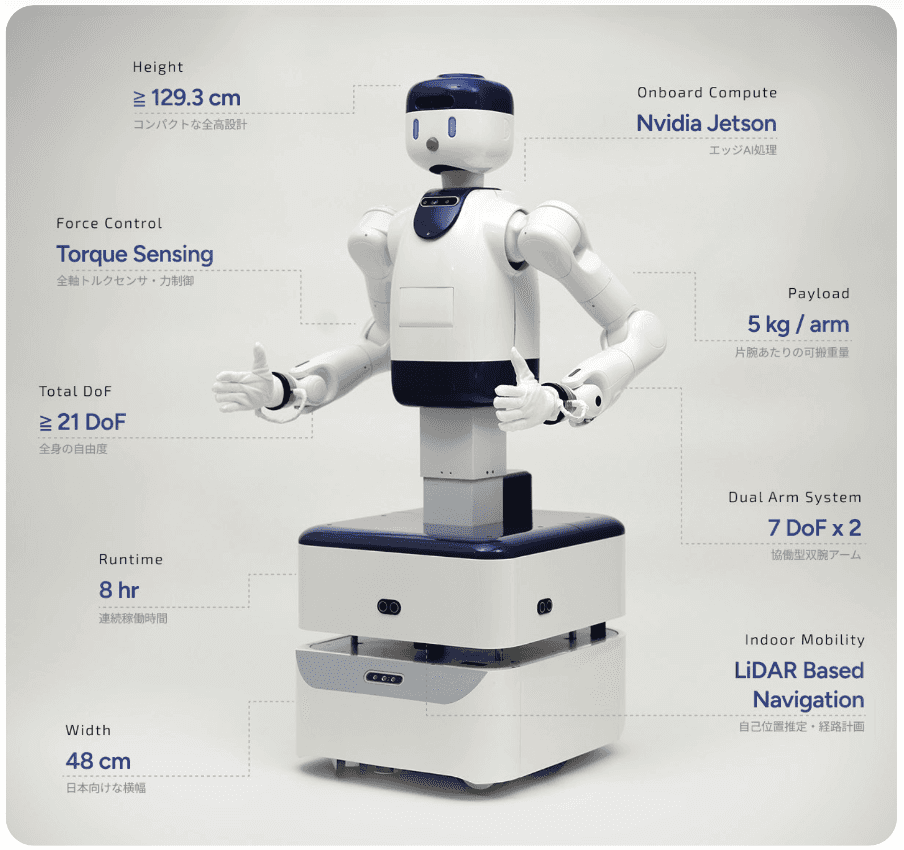
D1 is a ‘semi-domestic’ compact humanoid developed to coexist with people in Japanese indoor spaces and carry out specific tasks.
Hospitals, elder-care facilities, manufacturing and logistics sites, and hotels in Japan require robots that can move and operate safely amid narrow corridors, elevators, existing equipment and furnishings, and the flow of people.
D1 was developed with a focus on a size, price point, operability, and safety profile that make it easy to introduce into workplaces, as well as natural interaction with people.
D1 is not limited to dialogue and guidance. As a two-armed humanoid, it will expand into physical work support such as preparing supplies, assisting with meal service, weighing, transporting, and handing over items.
D1 has four key features:
1. World-Class Technology at a Starting Price of JPY 5 Million per Unit
By incorporating world-class technologies and components, D1 will be available from JPY 5 million per unit.
To move humanoids beyond research, development, and demonstrations into sustained operation in real work, it is essential to keep the price within reach for workplaces considering adoption.
However, keeping down the cost of the hardware alone is not enough for D1’s real-world deployment.
A system is also needed to support ongoing operation after adoption, including selecting the right tasks, adapting to the workplace environment, collecting data, training models, designing operations, maintenance, and preparing for potential risks.
Through collaboration with insurance and leasing partners and post-deployment operational support, ZEALS will create an environment where companies and facilities can introduce and continue using D1.
2. Compact Design: Approx. 129.3 cm Tall with a 48 cm-Wide Mobile Base
D1 is designed as a compact humanoid approximately 129.3 cm tall for use in Japanese buildings and indoor spaces.
With its mobile base kept to approximately 48 cm wide, it is designed for practical operation in typical Japanese indoor settings such as hospitals, hotels, and offices.
This compact design accounts for Japan’s built environment—limited corridor widths, doors, and elevators—and aims to create Physical AI that can coexist naturally with people and operate continuously in the same space.
Some overseas humanoids are human-sized or have large bodies, with use cases designed for spacious or dedicated environments.
In Japan’s indoor workplaces, however, it is important to be able to introduce robots directly into existing corridors, reception counters, waiting areas, elevators, back-of-house spaces, and factory work areas.
D1 is intended to enter existing indoor spaces in Japan without requiring major facility changes or robot-only environments, performing dialogue, movement, guidance, patrols, transport, and task assistance.
*Approximately 48 cm refers to the width of the mobile base.
3. Designed for Safe, Long-Hour Operation in Indoor Spaces Shared with People
D1 is developed with safety and operability in mind for long hours of use in indoor spaces shared with people.
Hospitals, elder-care facilities, and hotels are shared by diverse groups including older adults, patients, visitors, guests, and staff. Manufacturing and logistics sites likewise require safe operation amid workers, equipment, and transported goods.
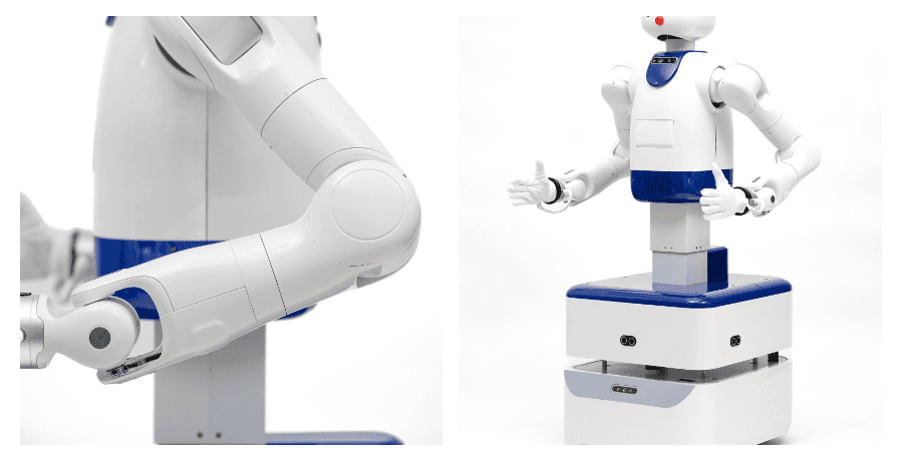
D1 is being equipped with torque sensors on every joint of its arms so it can detect contact with people or objects and stop movement. Its controls are also being advanced to detect people and obstacles while moving, and to operate at safe speeds along safe paths.
D1 includes a battery capable of operating for up to approximately eight hours, helping to minimize work interruptions for charging while supporting long-duration tasks such as reception, guidance, patrols, and transport. By combining safety with an operating time that can be integrated into real shifts and workflows, ZEALS aims to build a humanoid that can be used continuously.
In a prior proof of concept at University of Tsukuba Hospital, D1 completed validation in conditions close to a real hospital indoor environment with zero human contact and zero falls.
ZEALS will continue testing in real workplaces and establish a risk-management framework with insurance partners so companies and facilities can introduce and operate D1 with confidence.
4. Human Interaction Powered by AI Communication Expertise
D1 is a humanoid that emphasizes engaging naturally with people, not merely moving or carrying out tasks.
Drawing on ZEALS’ experience in AI customer service, AI agents, and AI avatars, D1 will advance real-world deployment from tasks involving human interaction, including natural dialogue, reception service, guidance, proactive communication, and multilingual support.
In healthcare and elder care, anticipated uses include guidance for patients and visitors, responding to inquiries, speaking with people while they wait, supporting older adults, and assisting with exercise and recreation.
In hotels, anticipated uses include guest guidance, in-building navigation, responding to inquiries, and multilingual communication.
In manufacturing and logistics as well, the ability to exchange information with people on site—for guidance, confirmation, reporting, and notifications when anomalies occur—is important.
Starting from dialogue with people, D1 will broaden the range of tasks it can support to physical work involving its two arms, including handing over items, meal service, preparing supplies, transport, weighing, and task assistance.
Accelerating D1’s Real-World Deployment with Partners in Four Areas
Deploying D1 requires more than robot development: it requires task adaptation, risk preparedness, financial support, and a workplace deployment and operations framework.
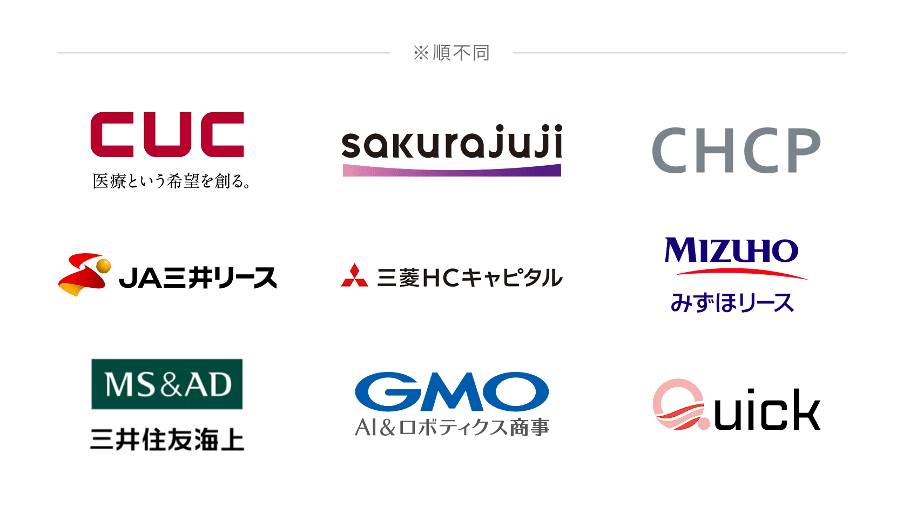
ZEALS is building an integrated support structure with partners in healthcare, insurance, leasing, and deployment, from use-case design through operational improvement.
Message from the CEO ZEALS Inc.
Representative Director and CEO Masahiro Shimizu
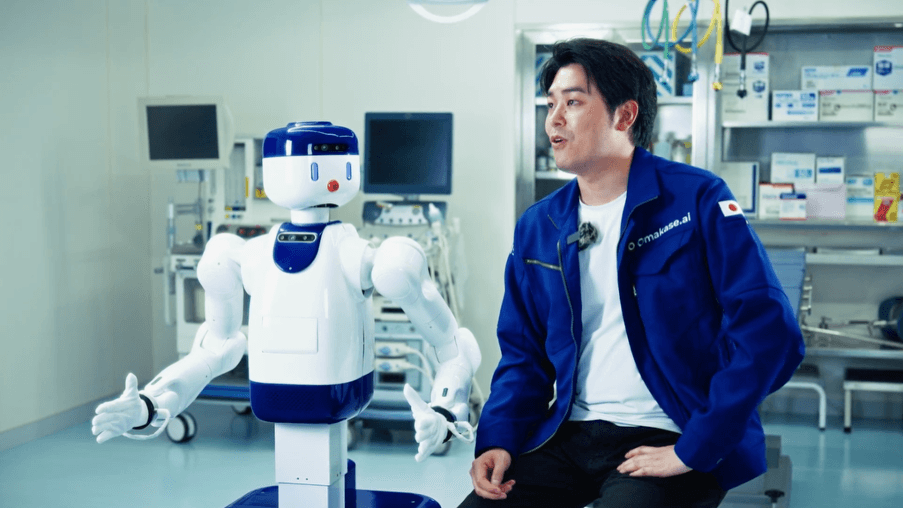
I currently spend roughly ten days a month in China, ten days in the United States, and ten days in Japan, seeing the evolution of cutting-edge Physical AI and humanoids firsthand. The United States and China lead the world in the scale of technology development and investment. Yet seeing the world has made me certain of Japan’s winning path: creating, ahead of the rest of the world, use cases in which humanoids do real work.
Japan concentrates the conditions and challenges needed to make humanoids practical: an aging and shrinking population, labor shortages, high expectations for service quality, complex operations, and limited indoor spaces. Precisely because Japan is at the forefront of these challenges, I believe it can become a leader in humanoid use cases.
D1 was developed not for laboratories or trade shows, but by working backward from what it takes to operate in real Japanese workplaces. It combines a starting price of JPY 5 million per unit, a compact design suited to Japanese indoor spaces, and human interaction that enables natural dialogue.
Our goal is not to deliver D1, but to keep it working continuously in real tasks. We will enter workplaces, gather data, learn, improve movement and operations, and create the conditions for D1 to continue working alongside people. We will begin by going deep into specific settings such as healthcare and elder care, advancing deployment steadily.
D1 deliberately begins as ‘semi-domestic.’ We will incorporate the world’s leading technologies and components while advancing AI, software, control, assembly, and deployment under Japanese leadership. This choice enables us to ensure safety and reliability in workplaces at speed. By designing and managing D1 from Japan, we can precisely implement the safety functions needed to work in spaces shared with people, while balancing world-class performance and an adoptable price.
First, we will build knowledge in Japanese workplaces and accumulate practical use cases and operational know-how ahead of the world. Then, together with Japanese suppliers, we will develop technology and manufacturing capacity and take humanoids born in Japan to workplaces around the world. Our ultimate goal is to create a fully domestically produced humanoid from Japan that can compete globally.
From Japan’s challenges, we will create a global standard. D1 is our first step.