

|
News
D1 Completes 15 Hours of On-Site Operation with No Collisions or Falls, Validating Elevator-Based Guidance, Lightweight Item Transport, and Tea Serving
ZEALS Co., Ltd. (Head Office: Meguro-ku, Tokyo; CEO: Masahiro Shimizu; hereinafter “ZEALS”), with the cooperation of the Sakurajuji Group, conducted a two-day proof-of-concept (PoC) demonstration using the compact humanoid robot D1 at Hospitalment Bunkyo Sendagi, a private nursing home with nursing care services, from Thursday, September 10 to Friday, September 11, 2026.
The PoC evaluated three tasks: (1) facility guidance involving elevator use, (2) transportation of lightweight items such as supplies and deliveries, and (3) pouring tea from a pot into cups.
ZEALS has previously tested D1 in hospital environments for tasks including visitor guidance, lightweight item transport, operation of tea-serving equipment, assistance with clearing meal trays, and leading exercise sessions. This latest PoC expanded the testing environment to a nursing care facility where residents live their daily lives.
In addition to movement within a single floor, D1 was tested on inter-floor travel using elevators, transportation of items between floors, and tea-serving tasks involving the handling of liquids. Through these trials, ZEALS assessed D1’s potential to adapt to everyday operations in nursing care facilities and identified challenges that must be addressed ahead of practical deployment.
D1 website: https://www.omakaserobotics.ai/
1. Background of the Proof of Concept
At nursing care facilities, caregivers and nurses are responsible not only for providing care to residents but also for a wide range of everyday tasks, including transporting supplies and linens, preparing beverages, guiding people around the facility, and facilitating recreational activities. While each of these tasks is essential to facility operations, their repetitive nature can place a significant physical and time burden on staff.
If robots can take on some of these ancillary tasks, facility staff could spend more time communicating with residents and providing care tailored to each individual’s needs.
ZEALS has previously tested D1 in hospital environments for tasks including guidance, item transportation, operation of tea-serving equipment, assistance with clearing meal trays, and leading exercise sessions. Nursing care facilities, however, differ from hospitals in that they are first and foremost places where residents live their everyday lives. Robots therefore need to operate while respecting residents’ daily routines and ensuring safety in environments where residents, staff members, and visitors are constantly moving around.
Against this backdrop, ZEALS deployed D1 at Hospitalment Bunkyo Sendagi, operated by the Sakurajuji Group, to test three tasks based on everyday operations in a nursing care facility. The initiative was designed to examine how technologies developed through ZEALS’ hospital trials—including conversational interaction, perception, autonomous navigation, and dual-arm object manipulation—could be applied to nursing care and daily-life support.
2. Overview of the Proof of Concept
Dates: September 10 (Thu.)–11 (Fri.), 2026
Location: Hospitalment Bunkyo Sendagi
Robot: Compact humanoid D1
Organizer: ZEALS Co., Ltd.
Cooperation: Sakurajuji Group and Hospitalment Bunkyo Sendagi
Primary tasks tested: Facility guidance, lightweight item transport, and tea serving
Hospitalment Bunkyo Sendagi is a private nursing home with nursing care services accommodating up to 50 residents across 48 rooms. The facility is a four-story building with nurses and caregivers on-site 24 hours a day.
On the first day, the team brought D1 into the facility, established its network connection, created a map of the facility, adjusted its navigation system, and progressively tested each task. On the second day, the team incorporated navigation data and adjustments from the previous day and conducted further task validation while collecting real-world operational data.
3. Main Tasks Evaluated
① Facility Guidance and Navigation
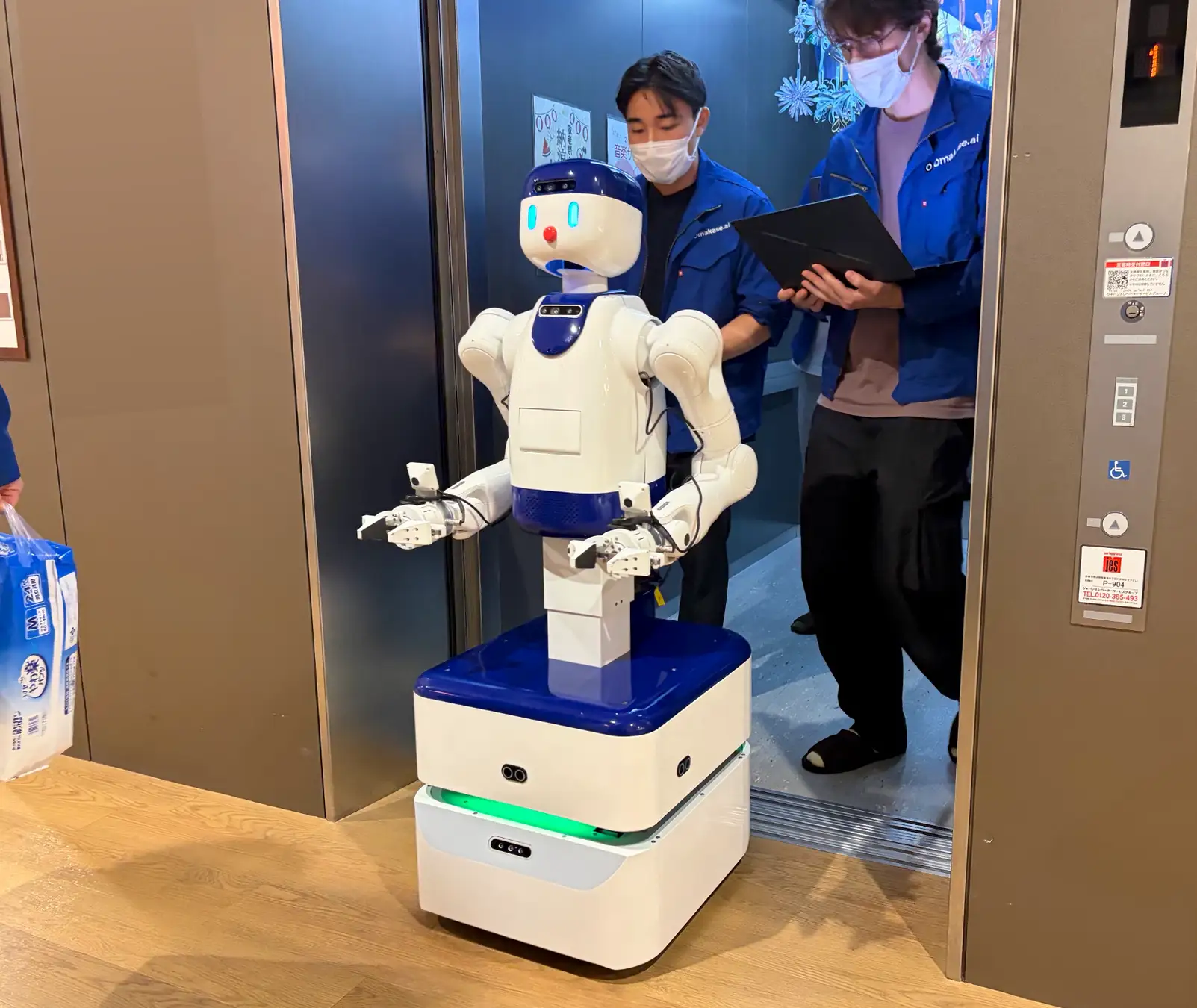
D1 autonomously navigated corridors and common areas based on a previously generated map of the facility, while also being tested on inter-floor travel using elevators and guiding people to destinations within the building.
When staff members spoke to D1, the robot autonomously guided them to destinations such as the office, entrance, restroom, and elevator. When using the elevator, D1 boarded together with people, exited at the designated floor, and continued autonomously to the destination. The team also confirmed that D1 could travel to the fourth floor and guide people to areas including the rehabilitation space and residents’ rooms.
Residents and staff members routinely move throughout the facility. D1 continued navigating while detecting nearby pedestrians and obstacles using cameras and sensors and adjusting its route accordingly. D1 also engaged in natural conversations with residents it encountered during the guidance task.
By using the facility’s existing elevators without requiring major modifications to the building infrastructure, the PoC demonstrated a practical approach to inter-floor mobility for humanoid robots in nursing care facilities.
Key validation items
Autonomous navigation through corridors and common areas based on a previously generated facility map
Confirming destinations through conversation
Guidance to the office, entrance, restroom, and elevator
Guidance to the rehabilitation area and residents’ rooms
Navigation in an environment where residents and staff members are continuously moving
② Transportation of Lightweight Items
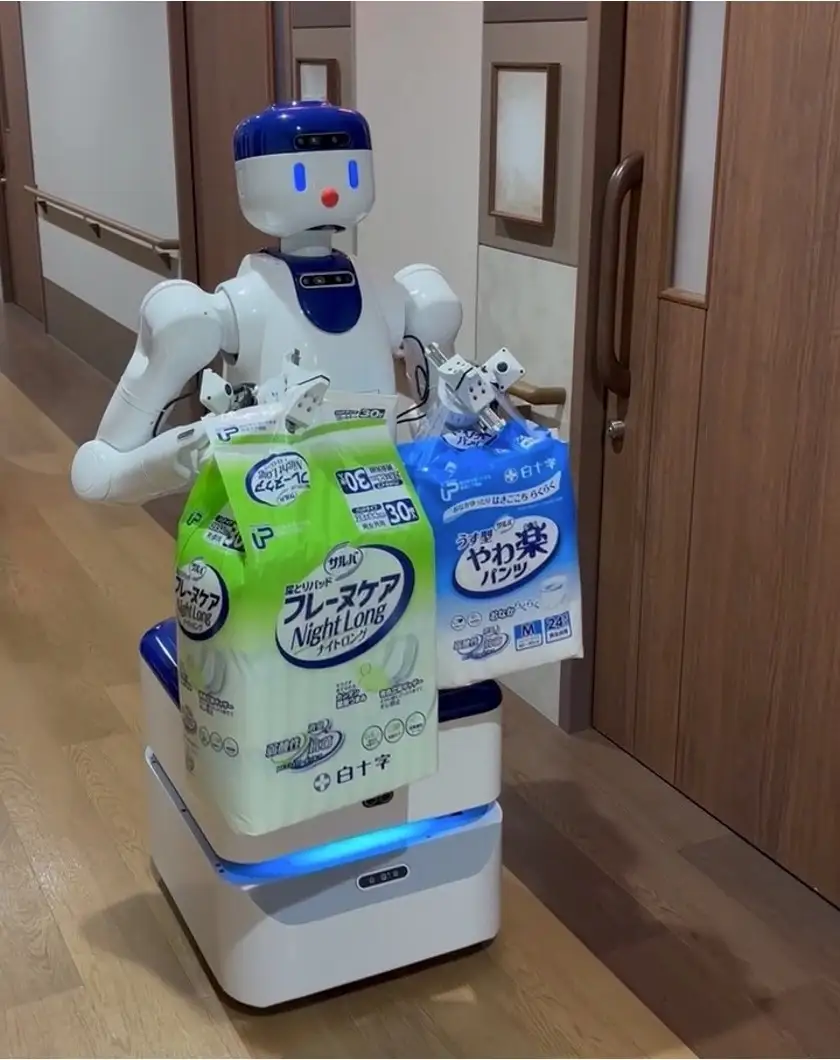
Unlike medical facilities, nursing care facilities are living environments where residents spend their everyday lives. As a result, staff members routinely transport not only nursing care supplies but also a wide variety of items associated with residents’ daily lives, including products ordered by residents, while simultaneously carrying out caregiving duties.
This PoC examined the potential for D1 to take on some of these transportation tasks. In the office, D1 received items directly from staff members, confirmed the delivery destination verbally, autonomously traveled while holding the item, and delivered it to the designated resident’s room.
Specifically, D1 transported adult care diapers from the office to a resident’s room. It also delivered an item ordered by a resident to the resident’s room. The latter was not a package prepared in advance for testing, but an actual delivery request that arose at the facility on the day of the PoC and was handled by D1 as part of the real-world operation.
Building on the navigation capabilities tested during the facility guidance task, the team assessed whether D1 could perform the combined action of navigating while securely holding an object. The testing also helped identify the range of item weights and shapes that D1 is currently capable of transporting.
Key validation items
Grasping and lifting items handed directly to D1 by staff
Confirming delivery destinations through conversation
Navigating from the office to a resident’s room while holding an item
Delivering the item to the designated resident’s room
③ Tea Serving
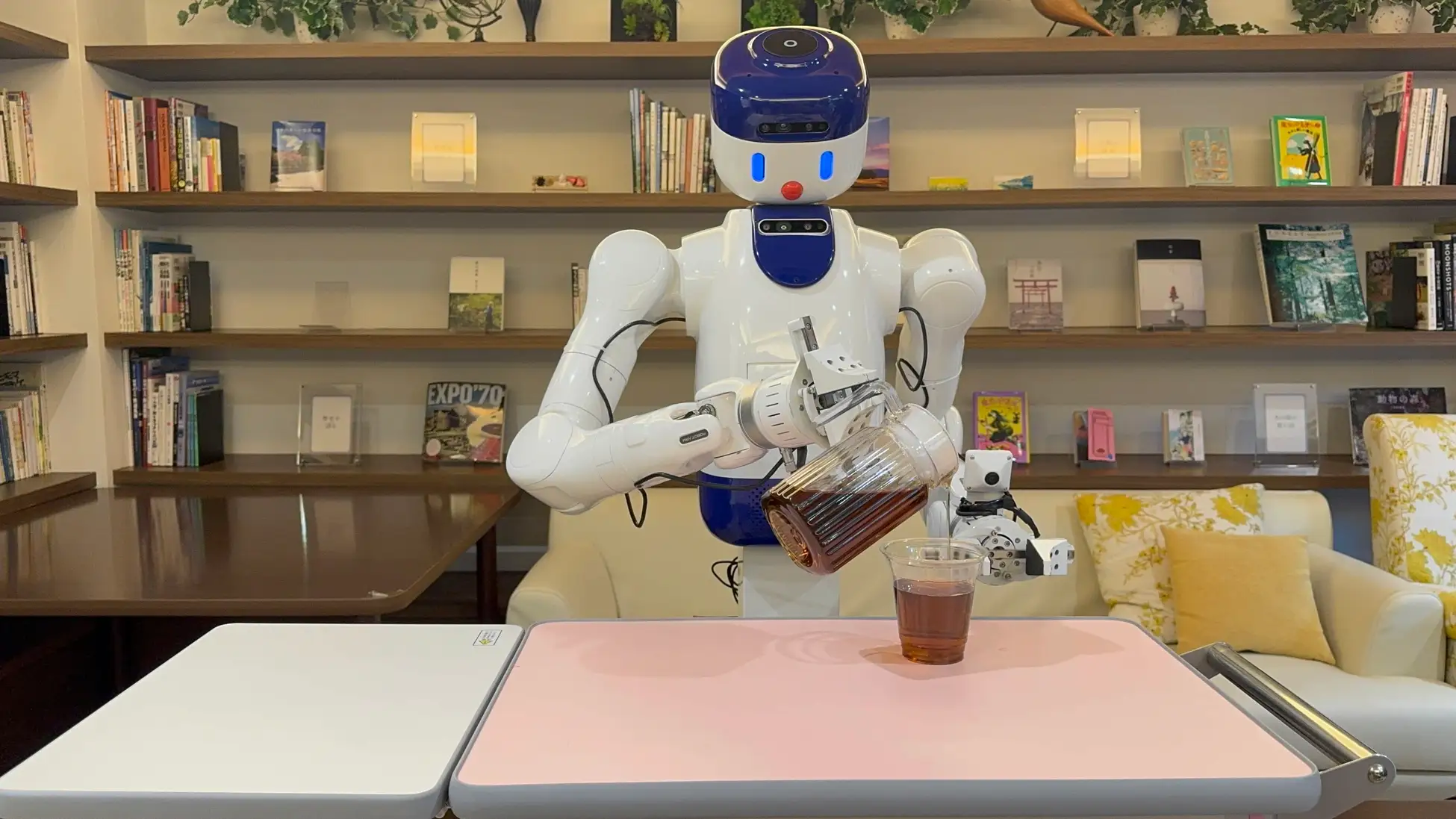
The team tested the complete sequence of D1 pouring tea into a cup and returning the pot to its original position.
D1 recognized the positions of the pot and cup in real time, lifted the pot, monitored the amount of tea being poured into the cup, and determined both the appropriate pouring angle and when to stop pouring. All of these actions were performed autonomously by D1 without remote operation.
The test confirmed the potential for D1 to autonomously perform tea-serving tasks even in an environment different from the one in which the task had been trained. At the same time, challenges remained in terms of movement stability and reproducibility.
Going forward, ZEALS will use the data collected during the PoC to further train and improve individual actions, including recognizing the pot and cup, grasping the pot, and pouring liquid, with the aim of enabling D1 to perform the entire sequence more consistently.
The PoC also helped ZEALS assess the potential reduction in staff workload associated with beverage preparation and better understand the amount of training data and operating conditions required for practical deployment.
Key validation items
Recognizing the pot handle and securely grasping and lifting the pot
Controlling the pouring angle to regulate the amount of liquid dispensed
Assessing the amount poured into the cup and determining when to stop
Returning the pot to its original position after pouring
Autonomously performing the complete sequence without remote operation
4. Significance of the PoC and Next Steps
This PoC expanded D1’s testing environment from hospitals to a private nursing home with nursing care services, with the aim of identifying specific tasks that humanoid robots can perform in residents’ living spaces as well as operational challenges that must be addressed.
D1 operated on-site for eight hours on the first day and seven hours on the second day, for a total of 15 hours across the two-day PoC.
For facility navigation, the team tested inter-floor movement using elevators, expanding the range of environments in which D1 can operate and the scope of tasks it can potentially perform. For lightweight item transport, the PoC assessed D1’s potential to support part of the routine transportation work currently carried out by facility staff. For tea serving, the team collected real-world data required for precise manipulation involving liquids.
In August 2026, ZEALS conducted its first D1 PoC in a medical setting at Keimeikai Medical Corporation’s Juko Osu Hospital. D1 operated for a total of 35 hours over three days and was tested across five hospital tasks, ranging from visitor guidance to assistance with clearing meal trays. Throughout the trial, there were no collisions with people or facility equipment and no falls, confirming D1’s ability to perform tasks in an active medical environment where patients and staff members move throughout the facility.
By expanding the testing environment to a nursing care facility in this latest PoC, ZEALS has now continuously demonstrated, within a span of just over two weeks, D1’s ability to perform real-world tasks in two distinct environments—medical care and nursing care—with zero collisions with people and zero falls in both settings.
ZEALS will use the data collected through these PoCs to further train, evaluate, and improve D1. Together with the Sakurajuji Group, ZEALS will also explore specific use cases for humanoid robots in nursing care facilities and discuss opportunities to expand deployment to other Hospitalment facilities.
Comment from Makoto Sugaya, Head of Operations, Sakurajuji Group
“As labor shortages in the nursing care sector continue to intensify, reducing the workload placed on staff has become an increasingly important challenge.
While we are considering potential applications for direct care assistance in the future, we believe that beginning with the automation of everyday tasks such as transporting items and guiding people around the facility could provide significant support to frontline staff.
The value of this initiative extends beyond simply improving operational efficiency. By freeing up time, staff members can devote more attention to conversations with residents and to the warm, human-centered care that only people can provide. This trial represents an important first step in determining whether humanoid robots can evolve into an indispensable presence capable of supporting practical work in the nursing care sector.
Before deployment, we had some concerns about how residents might react to the robot. In practice, however, D1 was accepted smoothly without any significant resistance, and residents responded positively to its endearing movements and expressive behavior.
We see significant potential for D1 to contribute as a member of the team working alongside staff within the facility while helping reduce their workload. Based on the insights gained through this trial, we will continue working with ZEALS to develop concrete operating models that can deliver genuine value in nursing care settings.”
Makoto Sugaya
Head of Operations, Hospitalment Business Division
Medical & Nursing Care Well-Care Business Headquarters
Sakurajuji Group
About D1
D1 is a compact humanoid built in Japan, designed to share indoor space with people and to take on specific tasks.
ZEALS sources parts and technology worldwide, and leads in Japan on AI, software, control, assembly, and how the robot is introduced and run on site.
D1 stands about 129.3 cm tall, with a mobile base about 48 cm wide. It is being built for natural conversation, reception and guidance, autonomous navigation, obstacle avoidance, and multiple languages, and is being extended into physical work such as preparing supplies, carrying items, and handing them over with two arms.
Pricing is planned to start at JPY 5 million per unit. Sales inquiries opened on August 5, 2026.
■D1 site: https://www.omakaserobotics.ai/en
About the Sakurajuji Group
“WELL-BEING FRONTIER — Enriching Life in the Era of 100-Year Lifespans.”
Under its mission of “Enriching Life in the Era of 100-Year Lifespans,” the Sakurajuji Group operates a wide range of businesses and services designed to enhance people’s well-being and quality of life across three areas: Medical, Experience, and Solution.
Group website: https://sakurajuji.com/
About ZEALS
Company name: ZEALS Co., Ltd.
Established: April 1, 2014
Capital: JPY 100 million
Head office: ARCO Tower 6F, 1-8-1 Shimomeguro, Meguro-ku, Tokyo, Japan
Representative: Masahiro Shimizu, Representative Director and CEO
Business: Development and provision of Omakase AI, D1, Omakase Zen, Omakase OS, ZEALS AI Agent, and related products and services
Corporate website: https://zeals.ai/jp/
D1 website: https://omakaserobotics.ai/