

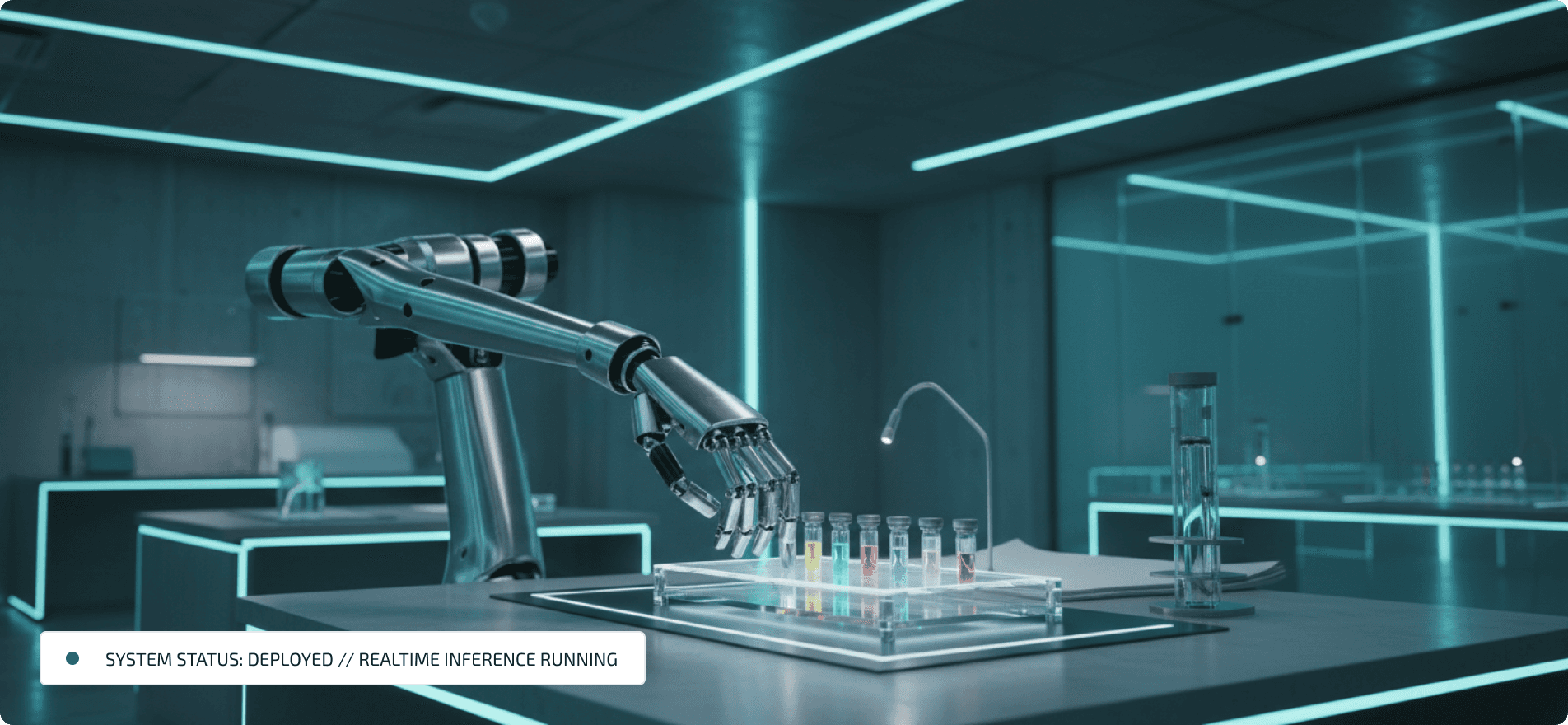
01. INTELLIGENCE IS NOT A MODEL
Intelligence is not a model. It is an improvement loop.
Zen is the collective name for the intelligence that enables robots to understand and perform hands-on tasks in real-world environments, as well as the model and data infrastructure that continuously improves that intelligence. Robotics research is advancing rapidly, with new architectures such as Vision-Language-Action Models, or VLAs, and World Action Models emerging one after another. However, model architectures and hyperparameters evolve every few months and are widely shared through research papers and open-source projects. We do not consider ownership of any particular model to be a sustainable competitive advantage. What matters is the ability to deploy robots into the real world, transform operational data into learnable assets, evaluate performance on physical robots, and continuously repeat the improvement process. At the core of Zen is not a model itself, but an improvement loop connected to the real world.
TL;DR // EXECUTIVE SUMMARY
01 — Zen is an intelligence and learning platform that enables robots to perform hands-on tasks.
02 — Today, Zen combines VLAs, skill policies, and state machines to break long procedures into multiple subtasks and execute them sequentially.
03 — In the future, Zen will hierarchically integrate high-level planning by VLAs with precise physical control by World Action Models.
04 — Zen converts data from physical robots, simulations, and human demonstrations into learnable formats through a unified data platform.
05 — Zen’s competitive advantage lies not in any specific model, but in the speed at which it can generate improvements in the real world.
02. FROM INSTRUCTIONS TO ACTIONS
Turning verbal instructions into physical actions.
“Prepare for a blood draw.” Although this is a simple instruction for a human, a robot must perform a series of decisions and physical actions to complete it. Zen decomposes abstract instructions into concrete subtasks and invokes the most appropriate policy for each one.
TASK DECOMPOSITION PATHWAY
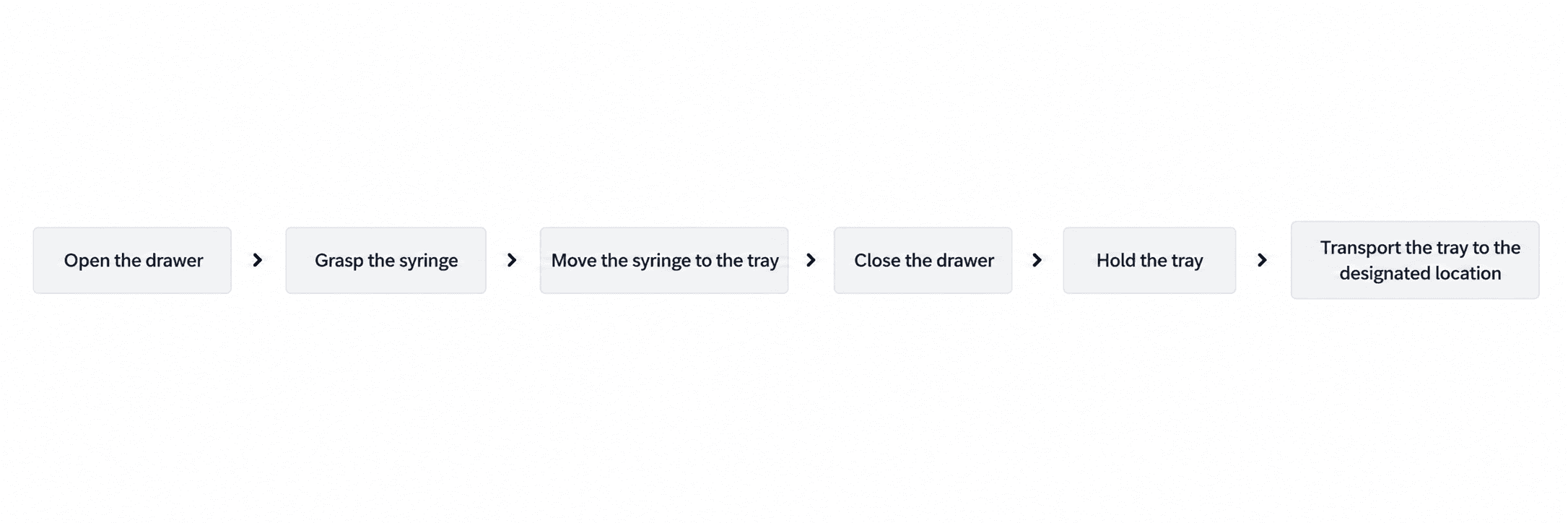
At the highest level, the overall task is decomposed and sequenced through a state machine. The VLA handles language understanding and generalization when objects or locations change. Precise movements involving physical contact are performed by skill policies acquired through Transformer-based imitation learning.
03. PROVEN IN THE REAL WORLD
Validated in the real world from day one.
In a proof-of-concept trial conducted at the University of Tsukuba Hospital in June 2026, Zen demonstrated its ability to operate within complex, real-world healthcare workflows. Rather than developing intelligence that functions only inside a simulator, we focus on system architectures designed to adapt to constantly changing physical environments. This includes the integration of state machines, specialized skill policies, VLAs, and Omakase OS, which orchestrates these components as a unified system. Zen is designed to achieve highly repeatable, error-resilient, and autonomous task execution across a wide range of operational environments.

04. VLA × WORLD ACTION MODEL
Intelligence that plans. Intelligence that moves.
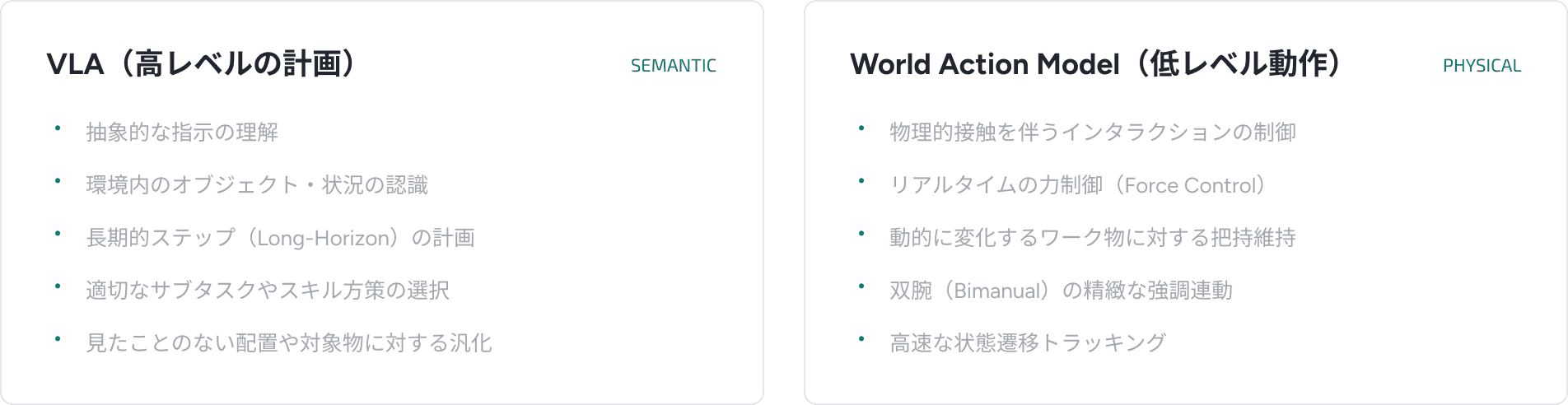
Zen hierarchically integrates these two components to achieve both advanced cognitive capabilities and precise motor control. Planning intelligence bridges the gap between an instruction and the conditions of the actual environment. Action intelligence adapts to microscopic physical factors such as friction, resistance, and contact forces.
05. FROM RAW DATA TO ROBOT POLICY
Turning real-world experience into learnable assets.
PIPELINE // RUNTIME LOGS // SUCCESS RATE: 99.8%

06. ONE TIMELINE ACROSS EVERY SENSOR
Data quality begins with time synchronization.
Camera footage at 30 Hz, robot-arm joint-angle measurements at 100 to 500 Hz, and pressure signals from tactile sensors at 100 to 1,000 Hz must all be mapped onto the same timeline. Without precise synchronization across sensors operating at different sampling rates, imitation-learning systems and trajectory-prediction models cannot learn accurately. Zen’s data infrastructure uses real-time ring buffers, precise hardware interrupts, and Precision Time Protocol, or PTP, to keep system-wide temporal error below one millisecond.
07. LEARNING ACROSS ROBOT BODIES
Preserving learned capabilities, even when the robot changes.
Zen defines its data representations at a level of abstraction that does not depend on the specific kinematic structure or inverse-kinematics configuration of a particular robotic arm. By aligning movements in end-effector space—[x, y, z, roll, pitch, yaw, gripper]—Zen can transfer learned foundational capabilities and shared physical concepts across robotic arms with different degrees of freedom, manufacturers, and body sizes. These concepts include actions such as “pouring” or “placing something down gently,” which require an understanding of physical contact and interaction.
08. REAL, HUMAN, AND SIMULATED DATA
No single data source can fully represent the real world.

09. DATA THAT ONLY DEPLOYED ROBOTS CAN CAPTURE
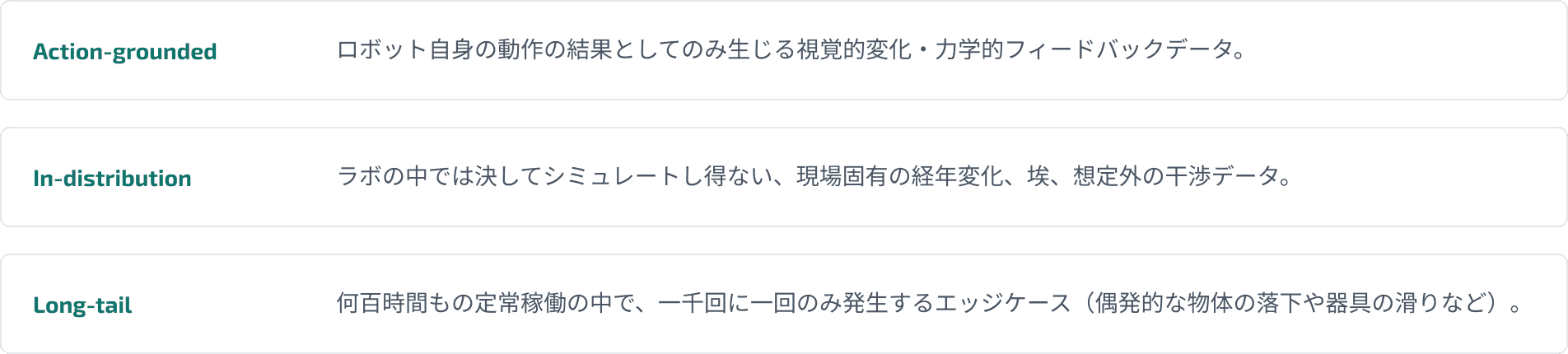
Some data can only be captured by embodied systems deployed in the field.
10. THE SELF-IMPROVEMENT LOOP
The more robots are deployed, the faster the next improvement becomes.

Data generated through real-world task deployment improves the performance of the next generation of learning models. As those models become more reliable, they enable increasingly advanced forms of automation. To prevent uncontrolled behavior or unintended actions during autonomous improvement, self-learning is conducted only under controlled conditions, including secure laboratory environments and evaluation sandboxes equipped with physical models and safety assertions.
11. THE MOAT IS THROUGHPUT
Competitive advantage lies in the speed of improvement.

A state-of-the-art model described in a single research paper can be reproduced. What cannot easily be reproduced is the throughput of an entire system that continuously turns data into evaluation, learning, and automated improvement. Zen’s competitive advantage lies in the ecosystem architecture that scales this closed loop faster than anyone else.
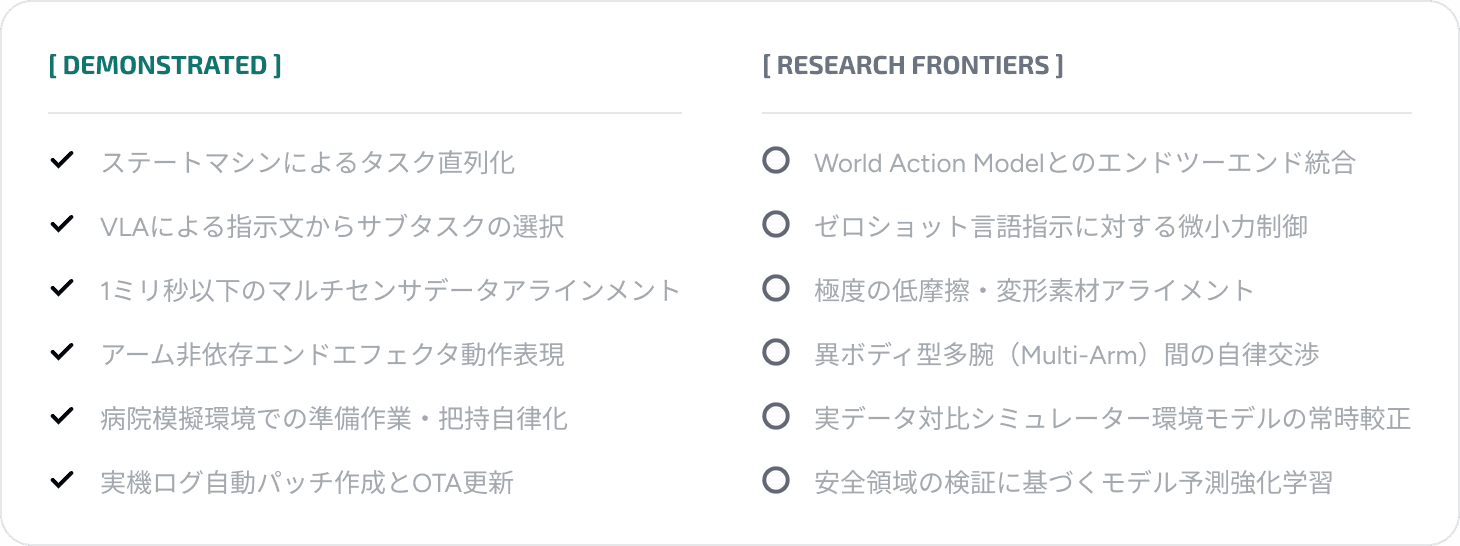
12. CURRENT STATE AND THE PATH FORWARD
Technologies already validated, and the challenges still ahead.
13. TOWARDS ROBOTS THAT KEEP LEARNING
Robots that work in the field and learn from the field.
The era of fixing robots to one specific task through one specific program is coming to an end. Zen envisions a world in which intelligent systems deployed around the globe share their experiences and continuously expand their capabilities. A task that could not be solved yesterday can be learned today and performed by a physical robot tomorrow. Step by step, we are building the path toward that autonomous future.
Deploy robots into the real world.
Turn real-world experience into data.
Turn data into the next capability.